Wednesday, June 19, 2013

Kissing bugs get some love

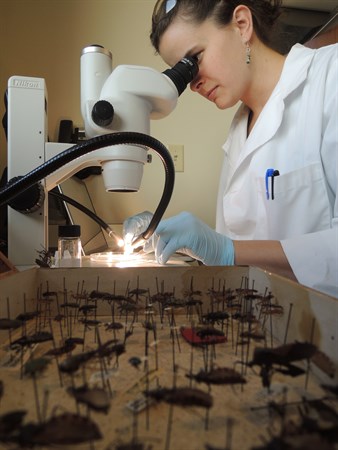
Rachel Curtis at Texas A&M University studies
Chagas disease eco-epidemiology.
.
One of the odder, and a little scary, pests that occasionally enter homes in Texas is the kissing bug, Triatoma species.  Kissing bugs aren't very good kissers, but they get their name from their habit of biting sleeping humans on the face at night.  Even worse, the "kiss" of the kissing bug can sometimes bring with it a parasite, Trypanosoma cruzi, that causes Chagas' disease.

If you are a blood donor you may have heard of Chagas' disease.  It's one of those mysterious illnesses you get asked about before you give blood. Thankfully, it's not thought to be common in the U.S., but is a very prevalent in some parts of Central and South America.  Recently there has been growing concern that Chagas' disease may be becoming more common in the U.S., and that it's occurrence might be underestimated.

A research team at Texas A&M University is beginning to study the different kissing bugs in Texas.  They hope to learn more about where kissing bugs are active, where different species are found, what hosts they prefer, and how often the parasite infects the bugs.

 Triatoma kissing bug are 1/2 to one inch-long.
If you come across a kissing bug, the Hamer Labs team would be interested in getting samples. It's important not to touch the kissing bug (they could be carrying germs and they can bite), but scoop it up in a small container or plastic bag.  If the bug is collected in a client's home, advise them to clean any surfaces that the bug may have crawled on with a disinfectant cleaner. If you find a kissing bug and want to donate it to the project, they ask that you first contact them via the email address kissingbug@cvm.tamu.edu. They will provide you with specifics on how and where to send.

For a brochure about the project, go to http://vetmed.tamu.edu/media/513063/kissing%20bug%20brochure.pdf

Tuesday, June 18, 2013

TDA announces new penalty guidelines

It would be nice if we all would be motivated to do the right thing solely by the promises of good things (carrots!).  But in reality most of us need painful consequences (the proverbial stick!) to keep us consistently honest.  That's the reason for the new Texas Department of Agriculture (TDA) penalty matrix.

On June 14 the TDA and the Structural Pest Control Service published new penalty guidelines and a penalty matrix (table) for companies in violation of pest control rules and regulations.  The TDA has always worked from a table of penalties, though the industry rarely saw it.  The new penalty guidelines and tables are an attempt to make the process more transparent to your business and the public.

Because these are not new rules or regulations, the penalty matrix does not require public input, though the TDA has indicated that it will accept and consider comments and recommendations. Draft versions of the matrix were previously shown to the Texas Pest Control Association and the Structural Pest Control Advisory Committee, and comments were incorporated into the final draft published last week. The matrix will go into effect July 1.

As a member of the Advisory Committee I hear comment from many of you concerning enforcement of rules.  I know one of the major concerns by conscientious applicators around the state is that penalties be significant, yet fair and consistently enforced.  The new matrix does involve increases in some fines, and is designed to encourage more consistency in penalty assessment over the previous matrix.

The table allows the TDA some freedom in determining the exact fine, and a fine may be higher that indicated on the table depending on intent of the violator and consequences of the violation.  I encourage everyone with a structural pest control business to become familiar with the matrix, and review it with employees this summer as a reminder that the carrot is always better than the stick.


Carabid invasion

Harpalus, ground beetle, carabid beetle
These inch-long beetles in the genus Harpalus are the latest insect
Texas plague to hit homes, businesses and schools.
The insect of the week, at least in east Texas, is a carabid beetle in the genus Harpalus. 

Ground beetles are fast-moving, predators that, as the name implies, forage on the ground. Outdoors they and their likewise predaceous larvae are found on the ground in all habitats, both grassy and forested areas.

Ground beetles have little interest in coming indoors, where there is little food. However they may accidentally enter homes or businesses when they slip under doors in their escape from daylight. Outdoors they hide under rocks, leaves, logs, etc. during the daylight hours.

Most ground beetles are relatively strong fliers and will be readily attracted to lights during their nocturnal mating flights. Typically these flights occur once a year over a one or two week period.

The current flurry of calls about what one inquirer called those “crunchy black beetles” is likely the result of a recent mating swarm. The current ground beetle invasion will be short-lived, but other species of ground beetles, like the caterpillar hunter, may be evident at other times of year. None of these species pose any real harm to people or pets (some have large enough jaws to bite if you pick them up), and they do help feed the birds.

No chemical control should be necessary for ground beetles. Beetles that are drawn into lights are either (1) going to be eaten by birds or other predators, or (2) going to fly away the next evening.  The best advice you can give customers who don’t like having all those crunchy beetles around, is to consider turning off the outdoor lighting around the account for part or all of the night. This should be necessary for only a week or so, until the flights subside.

If a customer insists on some control action, be aware of the recent label changes for pyrethroid insecticides. New pyrethroid labels do not allow application to concrete surfaces that will be exposed to rain. This would include sidewalks around buildings, and sides of buildings over concrete that not protected by eaves or canopies from the rain. Granular baits designed for crickets or cockroaches will not be effective against these predatory beetles.  For more information about ground beetles, the University of Kentucky has published a nice summary.

Thursday, June 13, 2013

New bed bug publication

If you've ever performed a bed bug control job you know it's not something you get exactly right the first time. Bed bug control requires knowledge of the pest, knowledge of the technologies available to control the pest, experience looking for the pest, and lots of muscle memory.
The new bed bug publication from Texas
A&M AgriLife Extension packs lot of tips
and information into 7 pages. Download it
free online.

If you've paid your dues, learned the routine, and think you've gotten pretty good at bed bugs, don't you wish prospective clients would recognize that?  Well now there's a new publication that might help.  How to Select a Bed Bug Provider (ENTO-033) is the latest entomology fact sheet from Texas A&M AgriLife Extension.  

By leading the reader through the different treatment approaches, and suggesting how to interview a prospective pest control company, this publication is designed to match bed bug sufferers to the best PMP.  Sections include:
  • What to look for in a pest control company
  • Approaches to bed bug control
  • Preparation
  • Warranties and follow-up
  • Cost
  • Bagging tips
  • Special considerations for apartment managers
In addition, we've included an interview card to help the user objectively compare you to other bidders. Criteria include experience, technician training and support, preparation requirements, good communication, monitoring, professionalism, warranty and follow-up.  

If you're really good at bed bug control, chances are that this guide will prospective customers see that. Maybe it should have a place among your sales material for future bed bug jobs. 


Tuesday, June 11, 2013

Voles, Moles and Pocket Gopher training

Vole.  Image courtesy the Play-Wright Flyer Guy blog.
Stephen Vantassel, Wildlife Damage Project Coordinator at the University of Nebraska, recently held a webinar covering management of voles, moles and pocket gophers.  Fortunately, thanks to the modern technology of webinar playback, the presentation is saved online so that you can view the information at your leisure.

The thing I appreciate most about Stephen's presentation is his emphasis on wildlife IPM.  Listening to the presentation I was particularly gratified to hear that wildlife management specialists have the same frustration as entomologists when it comes to IPM. The first question that I almost always get about an insect pest is "what's the best spray to kill it?" The reason this question is frustrating is that management of any pest is much more about understanding the pest, and about habitat modification.  IPM is not just about what chemical or special trap to use, its about correcting the conditions that lead to the pest problem.

So if you have interest in voles, moles or pocket gophers, check out this presentation when you have an extra 50 minutes. You'll get a good overview of an IPM approach to these three important landscape pests.

Thursday, May 30, 2013

ACE program growing and getting better

The Associate Certified Entomologist (ACE) program is growing in both numbers and maturity. This year has already been a banner year with the roll of Associate Certified Entomologists exceeding 640 and even a new Facebook page.
ACE Prep class held last fall at the Texas A&M AgriLife
Center in Dallas

Although I can't seem to get the hang of Facebook, many of you do it quite well.  So Facebook users, check it out, like it, and encourage the good folks at the Entomological Society of America (ESA) who are trying out  new ways to communicate with the ACE community.

Also, Chris Stelzig, manager of certification programs at ESA, has started a new service he calls  "Certified Science."  This is a blog, and a great way to keep up on the latest research that concerns urban entomology.  He lists urban entomology publications that have recently appeared in ESA journals, and provides a link to the abstracts. If after reading the abstract, you find that you want to learn more, you can sometimes find free copies of the full articles online, or else purchase a copy.  Certified Science is a service of the  for all Associate Certified Entomologists (ACEs) and Board Certified Entomologists (BCEs) who hold a specialty in urban and industrial entomology.

If you read my recent post on the ESA annual conference, you know that another advantage of certification is discounted registration for that meeting. Besides all the interesting talks, papers and posters, the Certification program has its annual Board meeting and certification program business meeting at the annual conference.  Show up once or twice and you might find yourself getting more involved with the program.

If you haven't taken the plunge, but are interested in certification, now may be the time. David Henderson, with Spring ISD in the Houston area, is organizing an ACE Prep Class this summer.  I and others will be conducting a day's review of the materials covered in the ACE exam.  If you have been studying and have already applied, paid your fees and been approved by ESA, we can give you the exam late in the afternoon.  It's a convenient way to take the exam with a group of fellow PMPs and a built in proctor.  Of course you don't have to take the exam.  The class can serve either as a kickoff for studying for the exam, or as a pre-exam review and confidence builder.  

The class will be held on July 11 at the Spring ISD Transportation Facility, 341A East Richey Road, Houston, TX 77073.  We start at 8:30 am and prep until about 2:30 pm.  The exam is offered from 3-5 pm. If you are interested contact David at dhenders@springisd.org. Cost is estimated to be $50 to cover my travel expenses (the larger the class, the lower the cost).
Wednesday, May 29, 2013

A unique opportunity for Texas IPM professionals

In case you haven't already heard, Texas gets to play host to a major event in the world of entomology and pest control this year.  The annual conference of the Entomological Society of America will be held November 10-13 in Austin.  The theme of this year's meeting is Science Impacting a Connected World, and approximately 3,000 entomologists from all over the world are expected to attend.

Many of you might be asking, "What's in it for me?"  In my opinion, plenty. The ESA meeting draws urban entomologists from all over the country to hear the latest in structural pest control research and activities. For a taste of the kind of information that you can hear at ESA, check out my past posts on ESA meeting highlights. In recent years ESA has become very welcoming to the pest control industry, even to the point of sponsoring special sessions for ACEs and other PMPs.

Rates for attending the meeting include early bird and on-site  registrations.  If you register before September 23,  ACEs can register for for $455 (comparable to the member rate of $430). Others pay $635 for early-bird and $765 for late registration. The meeting will be held at the Austin Convention Center.

This year the Texas IPM Affiliates for Public Schools (TIPMAPS) will be holding their annual meeting jointly with ESA. The TIPMAPS group is Texas' professional association for Public School IPM Coordinators.  They and Texas A&M University will be sponsoring a day-long program called Under the Lens, a CEU granting educational program and annual meeting featuring entomologists speaking on various topics including delusions of parasitosis, mosquitoes, pyrethroid label changes and fire ants, bed bugs, and rodent management around schools.  Advanced registration for the day is $100 (includes lunch) and $125 for on site registration. Although the program is designed for school IPM professionals, PMPs should also find the presentations and speakers of great interest. Registrants for the program will get access to the meeting exhibits and limited access to some of the scientific paper sessions. If you are interested in registering, or just want to learn more, click here.

Besides the TIPMAP event, a few of the symposia and paper sessions at the ESA meeting that might be of special interest to PMPs include:
  • Applied Research on Bed Bug Management
  • Arthropod Associated Allergy 
  • Healthy Schools: Research, Benefits and Impacts in the Classroom 
  • The Impact of Repellent Research and Development of New Arthropod Repellents 
  • Chagas Disease in the USA? A New Risk?  
  • Transmitting Mosquito Information: From Laboratory to Surveillance and Management in the Field 
  • How Cool is Entomology? 
  • Red Imported Fire Ants: Global Approaches to a Global Invasive Species 
  • Stored Product Entomology: Impacts on a Connected World 
  • Urban Entomology Presented Papers
  • Medical/Veterinary Presented Papers
  • Informal Conference on Insects of Ornamentals
  • Click here for a full listing of special symposia topics
Though some of the papers are highly technical, most of the urban entomology sessions should be accessible to anyone with a basic knowledge of entomology and an interest to see the latest science behind the craft. I hope many of you will consider attending.