Showing posts with label Orkin. Show all posts

Saturday, August 23, 2014

IPM Experience House: A training venue for pest control professionals

The structure for the planned IPM Experience
House already exists.  The house is an old
dormitory that will be remodeled as an extension
facility for pest control training.
How many hours have you spent in classrooms trying to improve your professional knowledge? Can you guess how many PowerPoint presentations you have sat through for the sake of CEU credits?  Now ask yourself, how many hours have you spent practicing new skills under the supervision of a knowledgeable teacher--someone who provided immediate feedback on your performance? Most of us would probably say we’ve spent a lot more time sitting than doing.

Of course there’s nothing wrong with a good classroom presentation.  But most of us also need hands-on instruction to help us grow and retain new ideas.  That’s the idea behind the IPM Experience House, a planned training facility at the Texas A&M AgriLife Research and Extension Center in Dallas.
IPM Experience House will be modeled after similar training facilities at the University of Florida and at the Orkin House in Atlanta, GA.  The idea is to provide a site where PMPs can practice new skills while getting feedback from teachers and fellow students. 

Wall cut-aways in the Orkin House remind
technicians what's behind the walls of a home.  
Features of the House will include wall cutaways to see normally hidden construction features, actual and mock insect damage, and sites to practice pesticide application.  The facility will include both an existing house retrofitted specially for pest control training, and an outdoor pavilion.  The pavilion will provide a year-round site to observe and interact with different construction features, such as crawl spaces, chimneys, and various foundations and walls.  The house will include a residential and commercial kitchen, hospital room, hotel room and possibly a mock daycare room. 

Besides the visible structure of the house, a critical part of Experience House is a behind-the-scenes curriculum.  Each feature of the house will be built with a learning objective and lesson plan in mind. The House will be set up to allow for different lessons to be tailored to each group.  Apprentices and technician trainees will have a set of training exercises for beginners, while advanced technicians and certified applicators will have more advanced courses to choose from.

An outdoor pavilion, similar to this structure at the
University of Florida's Pest Management University, is
planned as part of Phase II of the project.
Some have asked, why Dallas?  Why not build in College Station?  Since at least 1980 Texas A&M has had an urban entomology presence in Dallas. The Dallas Center currently houses two urban entomology staff, including myself and Janet Hurley, with the school IPM program.  In addition, Dallas is a regular training site for the Ag and Environmental Safety Department when training new technicians.  The Dallas/Fort Worth metroplex is also a major Texas pest control market.  Of the almost 15,000 certified pesticide applicators, techs and apprentices in Texas, about 28% work within a 1.5 hour drive of the Center.  This means that businesses can minimize training time and travel expenses by having a training site that is convenient and local.

IPM Experience House is further evidence of the Texas A&M University System’s commitment to the pest control industry. Experience House will complement the new Center for Urban and Structural Entomology and the Philip J. Hamman Termite Control Training School at the Texas A&M main and Riverside campuses, respectively, in Bryan/College Station. Together with the hiring of a new endowed chair of urban entomology, these activities reflect a time of tremendous growth for the relationship between the Texas pest control industry and the University.

The IPM Experience House has been, and will be, a team effort.  Since last year a group of 16 local business owners and industry reps have met as an advisory committee to craft a vision and a plan for the project. Out of this committee came a fundraising campaign and draft blueprint for the site.  By taking advantage of an existing building on the AgriLife campus, a currently unused student dormitory, the committee realized that building costs for the project could be kept to a minimum.  We estimate the cost of remodeling the existing dorm and constructing a 50 x 100 foot outdoor pavilion will be $250,000.  So far, through the generous donations of individuals, our local associations, and local pest control businesses and support industry, we have raised approximately $170,000 in external donations toward this cost.  The committee and I hope to start construction within the next six months.

We still need your help to make Experience House happen.  While Texas AgriLife is providing the land and the existing building, and a significant chunk of start-up dollars, it’s up to the pest control industry to help make this new training facility a reality.  If you or your company are interested in giving to IPM Experience House, click here to download a pledge card.  To learn more about the project, and see a blueprint of the building, visit http://citybugs.tamu.edu/experiencehouse


Thursday, May 2, 2013

Undercover Boss

John Wilson on Undercover Boss airs Friday
night on CBS. Photo: CBS.com
As a former Orkin employee many years ago, what I would have given to have the president of the company to ride around with me for a day.

Wait.  Who am I kidding?  I would have been scared to death.  Anyway, as Pest Management Professional reports, Rollin's President and COO, John Wilson, is doing just that tomorrow night on CBS' reality TV show "Undercover Boss".  Sounds like a winner to me, so I thought I would pass it on.

Tuesday, May 29, 2012

Urban entomologists in Georgia

Atlanta is home to historical memories of the Civil War and William T. Sherman's infamous march to the sea. It's also known for its peaches, the Atlanta Braves, Coca Cola world headquarters, and the Jimmy Carter Presidential Library.  It is lesser known as the home of Rollins Inc. and the Orkin University and Training Center, a state-of-the art training facility for Orkin sales and pest control staff. It is also lesser known for being the probable entry point into the U.S. for a new invasive insect known as the kudzu bug.

Orkin Trainer Jose Dolagaray explains the design and use of the
termite training facilities to conference attendees visiting the
Orkin University and Training Center at Rollins headquarters.
The last two points were of great interest last week, at least to the 220 or so entomologists attending the 2012 National Conference on Urban Entomology.  This is the largest conference in the U.S. (and likely the world) focused solely on the science of urban entomology, and is a great place to hear the latest news and research on bed bugs, cockroaches, termites, and many other urban insect pests.  Of the 43 talks I attended over three days, some of my personal highlights included the following reports [my apologies ahead of time to termite people--most of the talks I attended were bed bug-related]:

  • Dini Miller of Virginia Tech provided a very practical case study of failure to control cockroaches in what she said was the worst multifamily housing cockroach infestation she had ever encountered (and for Dini, that's saying a lot). Student researchers averaged 200 cockroaches per unit per night in 36 "high-clutter and poor sanitation" apartments in a city housing authority. Miller showed that baits can be effective in such poorly maintained apartments when the infestation was reduced significantly with a simple service involving application of 30 grams of gel bait per unit followed by a 14-day followup treatment.  When the units were turned back to the pest control company for maintenance, the populations increased to above the previous infestations within 4 weeks.  The reason? One technician was not sufficient to service the number of cockroach infested units in the complex, and not enough bait was being used in each unit to halt cockroach population growth. Miller showed that 45 minutes was required to put out an average of 916 grams of bait per unit during an initial visit.  With a good first treatment it only took 6 minutes per unit, and an average of 494 grams of bait, on a 14-day followup visit.
        The take home lesson from Miller's research is that pest control companies can't just go through the motions of baiting to get control of out-of-control cockroach infestations. Adequate time to survey, locate and treat cockroach harborages, as well as enough bait to manage the population is essential to a good treatment.  Miller's baiting formula (she used Advion and MaxForce Magnum gel baits) required 60 grams of gel bait per apartment when overnight trapping yielded more than 500 cockroaches, 30 grams for 100-500 cockroaches, and at least 15 grams for 50-100 cockroaches. AgriSense Lowline traps were used for all monitoring in the study.
  • The BASF folks generated food for thought with several studies of their products including two Phantom formulations, Alpine dust, and their pyrethrins aerosol, HydroPy. Jason Meyers reported that 4-month aged residues of Phantom SC, and 180 day aged deposits of Alpine dust, performed as well at controlling bed bugs as fresh deposits of the insecticides. Such long residual deposits are unusual in pest control, making it necessary for frequent re-treatments to prevent pest reestablishment.
         With this data in hand, Meyers made a case for what BASF will be calling proactive bed bug control.  Because of Phantom's long residual, the company is conducting field tests to see whether two proactive (=preventive) treatments a year can keep bed bugs from establishing in hotel rooms.  Treatments of Phantom aerosol are applied twice a year to bed frames/head board and luggage rack.  Alpine dust is used once a year and applied to hotel room box springs, electrical outlets, carpet edges, baseboards, picture frames, electronics and sofas/chairs.  So far no new infestations have occurred in a Kansas hotel being used as a proof-of-concept site.  Expect to hear a lot of discussion about whether this approach can be justified as IPM, and whether it works sufficiently well to write preventative contracts for bed bugs in hotels. According to Orkin entomologist Ron Harrison, Orkin is one large company that expects to do more proactive bed bug control with its hotel customers in the future.
  • Standardized assay methods for testing insecticides for bed bug control are a hot topic right now with regulators. One of the points of contention is which bed bug strain(s) to use. Bed bugs vary wildly in their susceptibility to insecticides.  Currently it is possible to pick a strain, like the almost completely susceptible Harlan strain, that will make nearly every insecticide look like a winner. But, according to Mike Potter of the University of Kentucky, 88% of bed bug populations tested from 110 sites around the U.S., had at least one type of resistance to insecticides.  Hence testing products against only the susceptible strains is nearly meaningless as a predictor of real-world effectiveness. But which strain or strains to use? It turns out that even the search for the perfect test strain is a moving target. According to Sumiko De La Vega, of Sierra Research Labs, even insecticide resistant strains lose their toughness after a few years in laboratory colonies.  One of Sierra's standard colony types lost most of its 2000-fold permethrin resistance over a 2-4 year period of no exposure to pyrethroid insecticides.  Frequent resistance testing may eventually become necessary for the performance of insecticide testing with bed bugs, making such tests more difficult and expensive.
  • Some of you may have wondered what happens to insecticide residues that are exposed to the high temperatures of heat treatments for bed bugs.  Apparently heat is not that destructive to residues of many of the commonly used bed bug materials. Temprid, Transport, Phantom SC, Phantom aerosol and a Phantom+IGR experimental formulation showed no loss in efficacy after 7 hours at 135 degrees F, according to PhD student Margie Lenhert from Clemson University.
  • More of us may be providing dinner for bed bugs than we realize, according to an Orkin in-house study conducted by Ron Harrison.  Harrison noted that early research conducted 50+ years ago suggested that perhaps over 80% of people showed some kind of reaction to bed bug bites. However, his informal study, using over 1400 Orkin company volunteers, showed that only 3.8% reacted quickly to bed bug bites. Only 1.1% showed any delayed (4 days or more) reaction.  If these numbers are accurate, the number of biting cases in hotels may be substantially under-reported.  In addition, lack of skin reaction in many people could explain why many customers who report infestations wait until bed bugs reach high numbers in a home or an apartment.
  •  
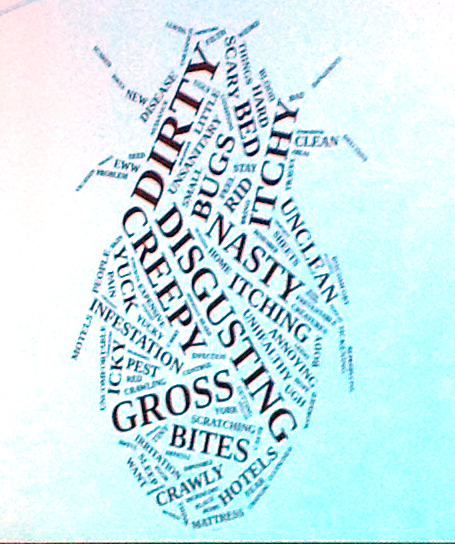
    NPMA graphic illustrating words that people use when
    asked what comes to mind when they hear the name
    "bed bug". The larger and bolder the word, the more
    common the response (graphic courtesy Jim Fredericks).
    Jim Fredericks of the National Pest Management Association reported on new online bed bug resources.  Allthingsbedbugs.org is a new consumer oriented site published by NPMA.  Its best management practices tab, however, would be a good place to compare your company's practices to see how they hold up to industry standards.
  • Rick Cooper, graduate student at Rutgers University, attempted to conduct field evaluations of bed bug sniffing dogs.  He noted that previous canine detection research reported in 2008 showed that dogs were capable of relatively high (95-98%) detection rates (correctly pointing out all bed bugs) and relatively low false positive rates (approximately 3% of the time dogs pointed to bed bugs that weren't there).  Cooper pointed out that the 2008 study was conducted under controlled conditions with planted bed bugs.  His study was conducted in real apartments, where bed bug infestation sites were well-known from previous, thorough checks by trained inspectors.  In one of his trials, he worked with 11 companies that claimed 95-98% detection rates (generalizing based on the published 2008 results).  In Cooper's study, actual detection rates in 48 apartment units averaged only 50% (ranging from 10-83%) for these companies, and the average number of false positives was about 20% (ranging from 0-43%). Even narrrowing the trial to his best, most experienced, teams, he was unable to replicate the high success rates of the controlled studies. Despite his respect for canine detection, he concluded that canine accuracy rates in the field are likely much less than what most canine handlers advertise, and that false alerts are higher in rooms with past history of bed bugs.  
         False positives are undoubtedly costing the public lots of money.  In a widely publicized bed bug infestation at the University of Nebraska, dogs used to inspect campus dorm rooms alerted in 197 of the 3256 rooms.  Evidence of bed bug infestations, however, were found in only 10 of the 197 rooms. Because of the publicity, and high public profile of the effort, all 197 rooms were treated, at a cost to the University of $400,000.  According to Cooper, the philosophy about canine detection is changing. In the past it was "trust the dog"; today, it's "check the alert" (with a visual inspection).
Strategically placed Plexiglas cutouts show trainees at the
Orkin house, normally out-of-site construction features
important to pest control, such as this bathtub plumbing. 
In addition to hours of Powerpoint slide shows, participants in the NCUE conference were treated to a field trip to the Orkin University and Training Center. The facility is very impressive with mock kitchens and grocery stores, numerous outdoor termite treatment training stations, and the Orkin House, a full sized home with numerous examples of pests, pest damage and structural cut-aways to show how homes are constructed and how insecticide treatments might interact with a building.  One of the highlights of the tour, for at least a few of us entomologists, was searching for the infamous kudzu bug on the kudzu vines so common in the Atlanta area.