
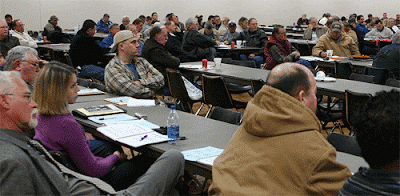
It always takes commitment to set aside a few days to improve your skills and knowledge. This is especially true when the destination is College Station in January. That's why it was encouraging last week to see almost 400 registered pest management professionals brave the weak economy and show up at the 63rd annual urban pest management conference and workshop at the College Station Brazos Center.
Organized each year by the Texas A&M University Center for Urban and Structural Entomology, the A&M Workshop may not be as well known nationally as other venues, but in my opinion the quality of the presentations and the professional fellowship to be found at this meeting is unsurpassed.
As part of his annual report, Dr. Roger Gold updated attendees on the State of the TAMU Center. Dr. Robert Puckett was introduced as the new Assistant Research Scientist, replacing Dr. James Austin. Puckett will help oversee all key research projects and training programs offered by the Center. The chair endowment, according to Gold, is currently valued at $1.6 million, and total grant income in 2008 was $570,600.
Head of the Department of Entomology, Kevin Heinz, announced a new initiative to begin a fund-raising drive to raise money for a major renovation of Center facilities. Gold was also honored by the Texas Pest Control Association for his 20 years of service to the Texas pest control industry. Mr. Bill Clark, of Bill Clark Pest Control in Beaumont, presented a plaque and expressed his admiration for the work Gold has done.
This year's special invited speakers included two Californians, Lloyd Smigel, of
Care Management Consultants at Valley Center, and Dr. John Klotz from the University of California at Riverside. For the Ivey Memorial Lecture, Smigel gave an entertaining presentation on the business side of pest control, with a special emphasis on the pitfalls associated with fam
ily-owned businesses. Klotz gave presentations on urban ants (identification, biology and management) and on emerging public health concerns with venomous arthropods. Klotz stressed the importance of good identification and discussed the challenges of ant control, especially of Argentine ants. He noted that 73% of California homeowners with ant problems attempt to control the problem themselves. But only 10% of homeowners achieved good control doing it themselves compared to 63% of those who hired a PMP. Klotz also signed copies of his new, co-authored book,
Urban Ants of North America and Europe at the meeting.
Jim Muse, Director of the Structural Pest Control Service, congratulated the crowd on getting their credits early in 2009. He encouraged all applicators to not wait until the end of the year, because schedule conflicts can always disrupt training plans, as he has observed. He cited several recent cases where licensees faced suspension for missing their planned, late-year education classes due to accidents or other emergencies. He gave an update on
recent changes to regulations affecting the industry. He noted that changes to rules affecting all the regulations except school IPM were adopted in late 2008. Many of the proposed changes to the rules that came out earlier this year scaled back in response to industry opposition. Examples include changed degree requirements for certification, length of time for required record-keeping (will remain at two years), and new rules that would have called for immediate license revocation should business insurance coverage gaps occur.
The industry, Muse said, can expect ongoing revisions including some substantial changes to the school IPM regulations.
The next Advisory Committee meeting to review proposed school IPM changes will be held on January 29. Copies of the proposed changes to school IPM rules have not been posted online, but can be obtained through professional associations including TPMA, TASB and TASBO.
Other highlights of the conference included the exhibitor venue, presentations from new and outgoing students, and hands-on training with short courses on Friday. If you've never attended this conference, you owe it to yourself to come and get your CEUs early next year.
 A couple of weeks ago I announced two upcoming ant Webinars, and made some comments about how Webinars were "the next big thing" in continuing education. I hinted that if you haven't tried participating in a Webinar yet, you need to. If nothing else you can impress your teenage kids at the dinner table with your growing computer skills. OK, maybe not. But there is another advantage of the webinar that I didn't mention. If the presenting agency is on top of things, and you miss the "real time" presentation, you can watch a Webinar later, at a time that's convenient for you.


