Little in life is black and white, and nowhere in pest control is this truer than for the insecticide DDT. Mention DDT in most circles today, and you'll hear "tsk, tsks", and see shaking of heads. "What were we thinking when we unleashed DDT on the world?"
Yet DDT had its moment in the sun, and doubtless scholars will continue to debate its benefits to humans vs. its environmental shortcomings for years to come. David Fincannon, a pest management professional and owner of A-All Pest Control in Plano, TX recently published a new video consisting of historical footage and interviews with some of the last surviving PMPs of the Second World War. In it, these men discuss their experiences with the new insecticide Gesurol, now known as dichloro-diphenyl-trichloroethane, or DDT. Watching this video may not change your mind about the environmental wisdom of DDT use, but it will give you a better appreciation for what DDT contributed to our nation's history.
I'm so thankful for David's interest in documenting some of the early history of pest control. One of his key interviewees is Dr. John Osmun, Professor Emeritus of entomology at Purdue University. Dr. Osmun was one of my favorite professors when I was a graduate student at Purdue. And one of my favorite parts of his class was listening to his many first person accounts of the early history of insecticide development and commercialization.
Showing posts with label DDT. Show all posts
Showing posts with label DDT. Show all posts
Monday, May 23, 2011


Monday, October 11, 2010
A closer look at bed bug resistance
An interesting story came out last month from the National Evolutionary Synthesis Center at U.C. Berkeley. The story does a nice job of explaining the connection between DDT and pyrethroid resistance, and why pyrethroid resistance has appeared to develop so quickly in the short time that bed bugs have re-emerged as an important North American pest (The one bone I have to pick with the story is its confusion of the relationship and terminology between pyrethrins and pyrethroids--there is no such term as "pyrethrums").
The answer is that when bed bugs reemerged this decade as a major pest they had already been "pre-selected" for resistance to pyrethroids by their previous exposure to DDT. Because DDT acts at a similar site in the nervous system as pyrethroids, researchers theorize that the same mutations that conferred resistance to DDT bestowed protection upon the bearers of those mutations from pyrethroids.
I remember John Osmun, one of my professors at Purdue University, recounting with excitement one of his early army adventures with bed bugs. As an entomologist with the military in the early 1940s he had been assigned to use a secret insecticide to treat bed bug infested army barracks. Almost miraculously, the long-persisting infestation was eradicated. The insecticide was, of course, DDT. Since WWII, DDT went on to become a widely used tool to manage many insect populations, including bed bugs. Unfortunately bed bugs have used their long experience with this insecticide to fight back against more advanced pesticides.
A recent study by Zhu et al (2010) looked at bed bugs collected from 97 locations in 17 states and found resistance to deltamethrin in 88% of the sites. Because of the scattered geographical sampling conducted in this study, the status of bed bug resistance in Texas is still tentative. The only sample from Texas collected and analyzed in this study was from Beaumont, and showed resistance based on one genetic mutation. Many of the samples revealed populations with another genetic mutation, or even two mutations. Relatively few populations sampled were classified as fully susceptible to deltamethrin.
This does not mean that resistant bed bugs cannot be killed with deltamethrin or similar products; but it does mean that the dose needed to kill will be greatly increased.
The research, especially the resistance maps of the U.S., should be considered tentative; but does give us a better idea why bed bugs are so difficult to control with standard pyrethroid insecticides. Even though the study focused on deltamethrin only, the results should be mostly applicable to all pyrethroids. Chlorfenapyr is the only other liquid residual insecticide that is widely used at the present time that is not a pyrethroid insecticide and to which bed bugs have no known resistance.
The answer is that when bed bugs reemerged this decade as a major pest they had already been "pre-selected" for resistance to pyrethroids by their previous exposure to DDT. Because DDT acts at a similar site in the nervous system as pyrethroids, researchers theorize that the same mutations that conferred resistance to DDT bestowed protection upon the bearers of those mutations from pyrethroids.
I remember John Osmun, one of my professors at Purdue University, recounting with excitement one of his early army adventures with bed bugs. As an entomologist with the military in the early 1940s he had been assigned to use a secret insecticide to treat bed bug infested army barracks. Almost miraculously, the long-persisting infestation was eradicated. The insecticide was, of course, DDT. Since WWII, DDT went on to become a widely used tool to manage many insect populations, including bed bugs. Unfortunately bed bugs have used their long experience with this insecticide to fight back against more advanced pesticides.
A recent study by Zhu et al (2010) looked at bed bugs collected from 97 locations in 17 states and found resistance to deltamethrin in 88% of the sites. Because of the scattered geographical sampling conducted in this study, the status of bed bug resistance in Texas is still tentative. The only sample from Texas collected and analyzed in this study was from Beaumont, and showed resistance based on one genetic mutation. Many of the samples revealed populations with another genetic mutation, or even two mutations. Relatively few populations sampled were classified as fully susceptible to deltamethrin.
This does not mean that resistant bed bugs cannot be killed with deltamethrin or similar products; but it does mean that the dose needed to kill will be greatly increased.
The research, especially the resistance maps of the U.S., should be considered tentative; but does give us a better idea why bed bugs are so difficult to control with standard pyrethroid insecticides. Even though the study focused on deltamethrin only, the results should be mostly applicable to all pyrethroids. Chlorfenapyr is the only other liquid residual insecticide that is widely used at the present time that is not a pyrethroid insecticide and to which bed bugs have no known resistance.
Monday, November 24, 2008
Report from Reno
 Five days and 27 pages of hand-scribbled notes later and I've returned from another Entomological Society of America annual conference. As usual, the meeting was an exhausting marathon of meetings and posters and mixers, sweetened by renewed personal contacts and much new and useful information about entomology and pest control.
Some of the sessions were probably topics only an entomologist would find fascinating, like measurements of insect diversity on Arizona mountaintops, how mosquitoes locate their hosts, or the history of DDT (which cost only $.18/ lb after WWII and even the famous Winston Churchill called "the miraculous powder"!). Nevertheless, there was much information that would be of great practical interest to a gathering of PMPs. Just a few valuable new insights and reports included:
- An update was given on colony collapse disorder (CCD) of honey bees by Diana Cox Fisher, a researcher from Pennsylvania State University, who believes that a combination of stresses and new, or re-emerging, diseases (not pesticides) is probably responsible for the current crisis in bee deaths--at least in the U.S. Currently the best correlation with CCD seems to be a disease known as Israeli Acute Paralytic Virus, although the jury is still out on this one. She noted at the end of her presentation that one out of every three bites of food that we eat is thanks to pollinators like the honey bee.
- Several interesting papers were presented on bed bugs. Mike Potter, of the University of KY, noted in his talk on the history of bed bugs, that within 5 years of the introduction of DDT, researcher John Osmun of Purdue University reported that it became nearly impossible for researchers to locate bed bug infestations to study. Tim McCoy, of Virginia Cooperative Extension, noted the importance and effectiveness of dusts as a tool in bed bug control. Tempo dust, Drione, and Tri-die dusts gave the fastest kill of all products (45 minutes to 6 hrs). Boric acid dust was the slowest, requiring over 18 days to kill. Dini Miller of Virginia Tech concluded that hydroprene was a useful additive to conventional sprays for bed bugs (especially resistant populations), though the effects of hydroprene are subtle and may not become evident until the second or third generation.
- One of the most interesting bed bug talks was given by Changlu Wang of Purdue
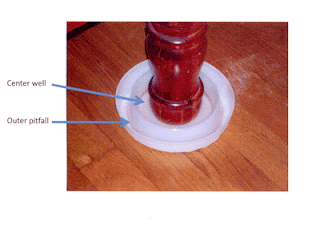 University. He compared spray-based and dust-based IPM programs for bed bugs. The liquid spray tested was chlorfenapyr, and the dust-based program used diatomaceous earth and an innovative bed bug interceptor device placed under bed posts to trap the varmits when they try to climb up, or down from the bed. The clever traps are being sold by Susan McKnight Inc. under the trade name Climbup™ Insect Interceptor. Both spray and dust-based programs worked well in Wang's tests. The traps caught more bed bugs than were observed by the inspectors in all apartments. Another interesting observation was that 94% of the trapped bed bugs were in the outer bowl, indicating that they were off the bed. This shows the importance of treating off-bed locations when controlling bed bugs. These devices might be especially useful for clients with low budgets and a high motivation to help with the elimination program. Of course the effectiveness of the bowls depends on eliminating contact of the bed and bedding with the floor and walls.
 - Tom Greene of the IPM Institute (organization running the Green Shield™ certification program for pest control businesses) reported results of a University of Florida study that showed that properly installed doorsweeps can reduce pest complaints in schools by up to 65%. He made an observation that I believe applies not just to school IPM programs, but to all professional IPM: "The question is not 'do you do IPM?', but 'how much IPM do you do?'" Most PMPs say they do IPM, but there is generally much room for improvement of the quality and depth of IPM done by professionals.

Subscribe to:
Posts (Atom)