Showing posts with label solenopsis invicta. Show all posts

Monday, August 28, 2017

Insects and floodwaters

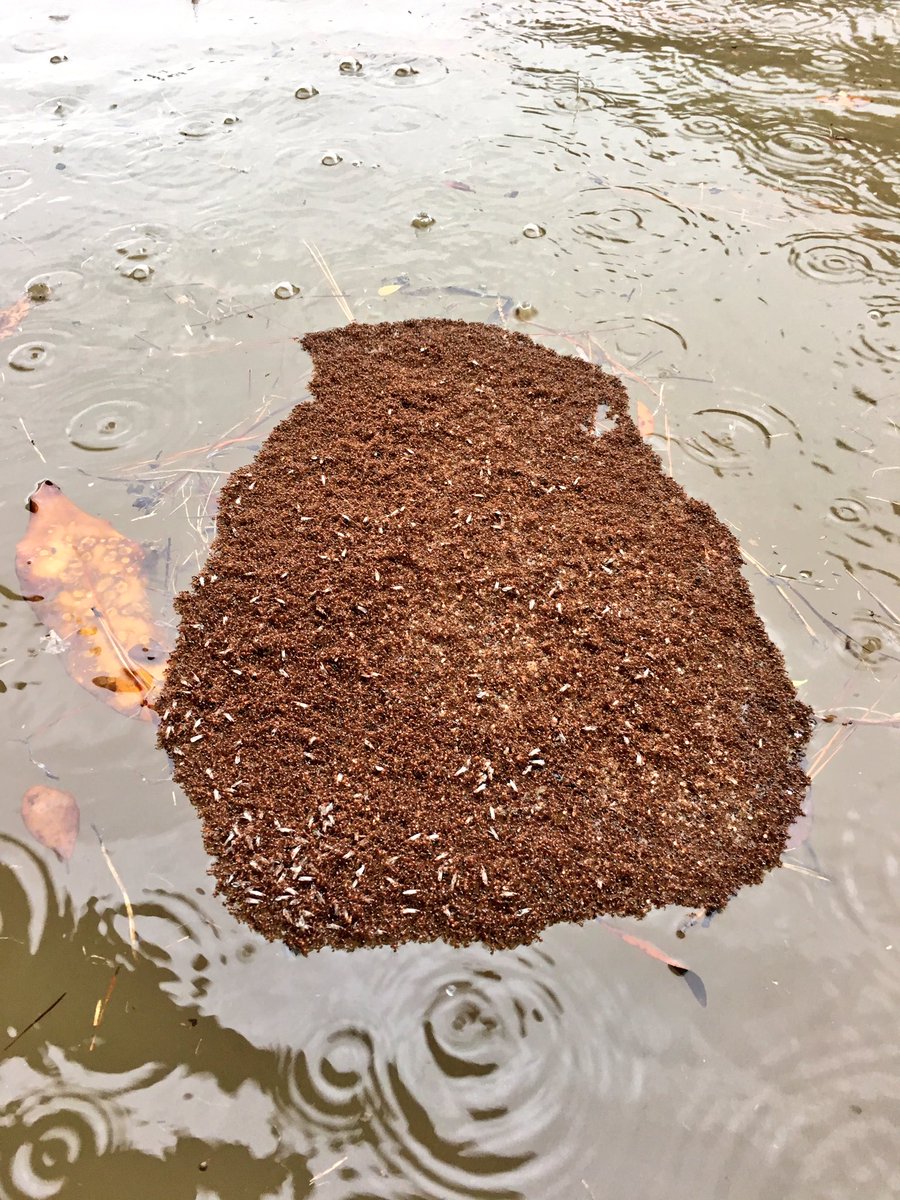
Fire ant floating colony in Houston floodwaters.
Photo by NBC DFW  @OmarVillafranca
Many in the pest control industry find themselves in the midst of the devastating floods hitting much of south and east Texas this week.  If so, it may be a good time to remind ourselves of some unique pest challenges associated with high water.

Flooding brings all sorts of wildlife into unusually close contact with people, but few critters are more dangerous than fire ants. When floods occur, fire ants exit the ground and float, instinctively linking their legs and forming a floating mat which is nearly impossible to sink. When they inevitably bump into a dry object like a tree, a boat or a person, the ant mass "explodes" with ants quickly exiting the mass and swarming the object.

Diving underwater, or splashing water on the ants, will not help.  The best option is soapy water, which is pretty good at killing the ants and helping drown a floating ant island.  According to the Texas A&M AgriLife Extension publication, "Flooding and Fire Ants:Protecting Yourself and Your Family", two tablespoons of soap in a gallon of water, sprayed on a floating mat is effective at drowning ants.  If any of you are engaged in water rescue this week, carrying a supply of soap along with a squirt bottle would be a good idea.

You might not have thought of it, but bed bugs can also become an issue after a public emergency like a tornado or flood.  When lots of people are brought together in an emergency shelter situation, the risk of bed bug encounters goes up.  The University of Minnesota has put together a nice publication on the subject. If you are in a community hosting an emergency shelter consider offering your services to inspect shelters and treat for bed bugs as necessary.  Don't forget the diatomaceous earth and silica aerogel dusts as a means of providing significant control for shelter bedding at minimal risk.

Lastly, after the storm is long gone be prepared for mosquitoes.  The primary mosquito species in the Texas Coastal Bend area are the salt marsh and pasture-land breeding mosquitoes. These are difficult to control at their breeding sites, short of aerial mosquito control campaigns.  But to some extent, these mosquitoes can be controlled in backyards with residual mosquito adulticides. If your company does residential pest control, but hasn't yet gotten into the adult mosquito control business, this may be a good time to start. One good way to educate your customers about the mosquito threat is the Mosquito Safari website.


Wednesday, March 16, 2016

Controlling fire ants in gardens

Fire ant carrying bait back to the nest.  Baits do not have to be
applied directly to a garden to control fire ants living inside a
vegetable garden.  USDA image courtesy Bugwood.
One of the common questions about fire ants concerns control within vegetable gardens. This is an especially common question directed to licensed applicators who work for school districts with school gardens.  It also may be an issue for PMPs servicing residential accounts with home gardens.

A standard, low-risk treatment on commercial, residential and school properties is use of a fire ant bait; however many of the most commonly used baits do not allow direct use in vegetable gardens. Fortunately, there is a work-around.

In most cases the simplest way to get fire ants out of a small- to medium-sized garden is to apply a fast acting fire ant bait around the outside garden perimeter.  This should be a legal application for all fire ant baits (check your label to be sure), and since fire ants do not pay much attention to garden edges, the garden infesting ants will readily pick up bait from the surrounding ground.  Yes the bait does end up inside the garden anyway, but only inside the fire ant nests, where there is no risk of it contaminating leafy vegetables.

For larger gardens or cropland where perimeter treatments might be less effective, several fire ant baits are legal for use.  Spinosad and abamectin-containing baits generally allow garden application (e.g., Clinch®, Fertilome® Come and Get It, and Payback®).  In addition, Extinguish® (but not Extinguish® Plus) fire ant bait containing methoprene has a label that allows use on cropland. However Extinguish is too slow for most gardeners, requiring approximately two months for maximum control.

In addition to baits, mounds can be treated directly with any of several mound drenches labeled for use in gardens.  The eXtension website contains recommendations for a two-step (bait and mound treatment) approach to fire ant control in both conventional and organic vegetable gardens.

Appreciation to Dr. Paul Nester (Texas A&M AgriLife) for supplying some of the information used in this post.


Monday, March 9, 2015

Get updated on fire ant baiting

Fire ants remain the most prevalent outdoor ant pest in most areas of the southern U.S.  Throughout the U.S. we estimate the annual cost of fire ant control at over $6 billion.  But the cost of this pest goes far beyond measurable dollars.  Fire ants reduce the recreational value of our parks and backyards, disrupt wildlife populations, and send thousands to emergency rooms each year from their painful stings.  

So as we get ready to enter fire ant season, it may be a good time to bring yourself and your staff up to speed on fire ant control. Many people are surprised to learn that fire ants are not an especially difficult pest to manage, once the biology and control tools are understood.

One of the best places to learn about fire ant management is the E-xtension fire ant website, a place where the best information about fire ant is assembled by Extension agencies throughout the South. This information was recently summarized and presented in an informative webinar by Dr. Fudd Graham, fire ant specialist with Auburn University.   Dr. Graham focuses on fire ant biology and use of baits for fire ant control.

It's worth knowing something about how fire ant baits work because they are the most economical, ecologically friendly, and effective control methods for fire ants. The webinar will provide you or your technician with an hour of training that should pay for itself many times over.  

Tuesday, May 6, 2014

Temperature: the key to fire ant baiting

soil thermometer
A simple soil thermometer can tell you the optimal times
of year and times of day for fire ant bait application.
Fire ant baits are wonderful tools for managing fire ants.  They are relatively inexpensive, require little labor to apply as broadcast treatments, and are safe for both applicators and the environment.  One of the biggest limitations of baits is that they cannot be used all year round. Instead applications must be timed to periods when fire ants are actively looking for food, foraging in ant worker lingo.

Many years ago a researcher at Florida State University, named Sanford Porter, spent an entire year (three times a day, once a week) monitoring fire ants coming to little bits of hot dog. Along the way he carefully monitored surface and below-ground soil temperatures, relative humidity, time of day, soil moisture, rainfall, and air temperature.  Porter found that by far the best predictor of fire ants foraging (and thus, when they are most likely to find and collect bait) was when the temperature of the soil at 2 cm (a little less than an inch-deep) was between 72 and 97 degrees F.

It makes sense that fire ants would be most sensitive to soil temperatures at this depth, as this is about how deep fire ants travel in their foraging tunnels, where they travel 90% of the time.  In Porter's study, fire ants nearly always found baits when the soil temperature was in the favored range.

This morning and afternoon I went outdoors and took the soil temperature in the lawn surrounding my office in Dallas, TX.  The temperatures at one inch averaged between 74 and 82 degrees, in morning and afternoon. This is the sweet spot for fire ants, and indicates that all day today would be a great time to use fire ant baits.

Typically we suggest fire ant bait applications in north Texas be limited to the months of May through September.  This ideal baiting time will vary from one location to another, but the soil temperature rule of thumb should be consistent.  If you're not sure when to apply fire ant baits, check the soil temperature with a metal temperature probe.

Daily temperature fluctuations

Besides time of year, soil temperature is also influenced by time of day. Right now, on the grounds surrounding my office, anytime during the day would be a good time to broadcast fire ant bait. But as any seasoned Texan will tell you, there's a mighty big difference in temperatures between May and July.  In July soil temperatures, even at one inch-depth, soar well over 100 degrees, effectively shutting down most fire ant foraging during the day.

The best time to apply fire ant bait during the summer months is late in the day, in the evening. Bait applied in the morning hours, even when soil temperatures are still favorable, will quickly be exposed to high temperatures and high UV intensity, both of which are likely to render bait less palatable to ants.  By applying bait late in the day, it will be available to fire ants during their most favored time for foraging, throughout the night.

For more information about baiting for fire ants, see our publications on Managing Imported Fire Ants in Urban Areas and Broadcast Baits for Fire Ant Control.


Saturday, October 5, 2013

Resources for fire ant control

Because fire ants have been such an economically important pest in this country, it's not surprising that a lot of research and extension resources have been developed to help manage these insects. In light of last month's tragic fire ant death, I thought it might be of interest to survey some of the different research-based information resources that are out there.

One of the best places to go for fire ant management information is eXtension.org's (pronounced EE-extension) fire ant management page.  Most states with fire ant experts now contribute to the resources on this site, making it a one-stop source for fire ant fighters.  If you prefer video training to lots of reading, eXtension has recorded webinars presented by fire ant experts from all over the country.  Subjects include fire ant control made easy, how to kill fire ants in sensitive locations, evaluations of different home remedies for fire ants, and protecting loved ones from fire ants.

In addition, the website serves as a collecting point for research proceedings from all the Annual Imported Fire Ant Conferences since 1984.  While this information is certainly for the dedicated reader, it's very interesting to see the original research on which most of today's fire ant control recommendations are based.

For many years one of the premier sites for fire ant control information has been the Texas A&M fire ant website. This site was developed largely under the leadership of now retired extension entomologist, Dr. Bart Drees, and has more information about fire ants than you ever thought to ask.

This site has been a repository for information from Texas' Red Imported Fire Ant Management Program, and has progress reports from this project dating back to 1998 as well as result demonstration reports from Extension researchers since 1986.  There is information about fire ant control for specific sites like organic gardens, homes and buildings, compost piles and health care facilities.

One of the most useful and comprehensive guides to fire ant control is the multistate publication on Managing Imported Fire Ants in Urban Areas.  Or if you like it simple, one of the most popular Extension publications ever is the Texas Two Step Method: Do-it-Yourself Fire Ant Control.  Need an hour of verified training for one of your technicians who needs to know about fire ant control?  Check out the Fire Ant Control Made Easy video series. Or have them sit down and learn all they need to know about fire ant baits--one of the most useful and cost-effective tactics for fire ant management--from the AgriLife Bookstore. And school districts needing to polish up their fire ant management plans might want to check out the Action Plan for Fire Ants.

Maybe you have your own favorite online fire ant control resource.  If so, tell us about it with the comment feature on this page.  There's really no excuse for not knowing a lot about fire ants with all the information out there.

Thursday, October 3, 2013

When it comes to fire ants, pay attention to detail

Because they are so common throughout the South, fire ant
risks are often underestimated.
Copyrighted photo courtesy Alex Wild.
In case you missed it, last month a 13-year old middle school student died  as a result of fire ant stings he suffered during half-time on a Corpus Christi, Texas football field.  The student, Cameron Espinosa, was on the sidelines when he complained of difficulty breathing after receiving fire ant stings on the field.  He collapsed and died several days later from complications due to an apparent anaphylactic reaction to fire ant venom.

The incident reminds me of how important good pest control is to everyone's health and well-being. It also gets me thinking about all the things necessary to doing a good job when it comes to fire ants.

I know this school district considered fire ant control important and took steps to control them, but a lot of factors go into controlling fire ants effectively on a football field, or in any sensitive site.  So I thought I would share some things that come to mind when I think about good fire ant control:

  • Know your fire ant insecticides.  Fire ant control insecticides include slow-acting baits (IGRs), faster-acting baits (spinosad, indoxacarb, hydramethylnon), slow-acting residual granulars (fipronil), faster-acting residual granulars (bifenthrin).  You also have a wide variety of products for mound treatments, most requiring water for activation. Each of these products has advantages and disadvantages.  Do you know them? If not, check with your state extension entomologist or a knowledgeable pesticide distributor.
  • Plan ahead.  Baits are less costly than most other treatments and fit in well with goal of using safer materials, especially at a school district.  But baits are slow, most requiring 1-2 months for peak control. Even non-bait, residual granular insecticides require time for control.  The popular Top Choice® granular insecticide (fipronil), requires 1-2 months to eliminate fire ant mounds in the treatment zone. These products are not designed to give good control two days before the first Friday night football game.
  • Know when and how to inspect a field for fire ants.  Fire ants are present in fields all year round, but they are most visible during cool weather, or just after a rain or heavy irrigation.  Inspecting the field at the wrong time could lead to a false sense of security regarding fire ant activity.  In some cases, especially during hot, dry weather, use of hot dog slices (possibly at night) can be the best way to measure fire ant activity.  Also, in the case of athletic fields it's a good idea to do a final inspection just before a game or practice. Fire ant mounds can appear within just a few hours, especially after a rain.
  • Know how to apply insecticides accurately.  Fire ant baits require specialized equipment designed to put product out at very low rates (generally 1- 1.5 lbs/acre). For large areas a Herd GT-77 spreader is a standard application tool.  Spyker rotary spreaders, or handheld seed spreaders are good for smaller areas. All spreaders should be carefully calibrated to make sure the correct amount is going over the field.  Too much bait and you will overspend on product, too little and you might not get the desired control.  The same is even more true for the more expensive granular residual products.
  • Know when to apply.  Fire ant baits are most effective if applied when ants are actively foraging. When soil temperatures are above 95 degrees F, fire ants stop foraging and retreat deep in the soil.  Baits applied during midday will degrade and lose their attraction before the ants return to the surface at night, when temperatures have dropped.  This means that in the heat of summer fire ant baits should be applied later in the day, just before evening.  Baits are also not effective during the cooler season, so baits applied between October and April, say, may not give you satisfactory control.
  • With baits it's also important to know the age of the product.  Fire ant baits don't have an especially long shelf life. So buying fire ant bait when its on sale late in the season for the following year may not be the bargain you think it is.  Buy your bait just before you need it, and only as much as you need.  Saving bait, especially opened containers, from one season to the next, is not recommended. If you are unsure of the quality of a bait, find an active nest and sprinkle some around the base of the mound.  If the bait is fresh the ants should quickly (within 5-15 minutes) pick it up and carry it underground.  
  • Don't rely on just treating mounds to manage fire ant problems.  Mound treatments can effectively kill fire ant colonies, but they do a terrible job of managing fire ant populations in an account.  That's because it is so difficult to find and treat fire ant mounds. A new fire ant colony may take 6 months to even produce a visible mound.  Broadcast residual treatments or broadcast applications of baits are much more effective because they treat all mounds, visible and invisible.  And they are generally less expensive than mound treatments.
  • Water, water, water. Water is a necessary part of treating individual mounds.  Without it you cannot effectively reach the lower parts of a fire ant nest.  One to two gallons of mixed insecticide, or 1-2 gallons of water to wash in a granular application, are mandatory for good control.  And don't expect immediate control with all mound treatments.  Aerosols and liquid drenches are fastest, but allow at least an hour with these treatments to ensure that ants in a nest are neutralized.
These are just a few of the details necessary to ensure that you've done the best you can to keep your accounts mostly fire ant free.  And remember that schools with athletic fields aren't the only sensitive sites. Playgrounds, nursing homes and other medical facilities, parks, event grounds servicing thousands of concert goers--all are places where fire ant control needs to be done right.

If you're a PMP servicing a school or park or a residential lawn, you can't do this all on your own. Communicate and enlist the help of your customers: coaches, park maintenance staff, or homeowners. Let them know about how to report problems and to know what to do in case of need for an emergency treatment.  And let your customer know about the importance of taking stings--any arthropod sting--seriously.  Anyone who experiences difficulty breathing, tightness in chest or throat, hives or rashes after a sting should seek medical assistance immediately.  

Fire ants, like all pests, are an inevitable part of life in Texas.  But that doesn't mean we have to live with them.