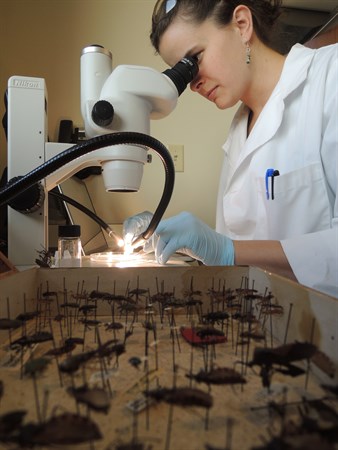
If you can imagine thousands of entomologists swarming a convention center like fire ants on Cheetos, that's what it was like at the 25th International Congress of Entomology (ICE) held in Orlando, FL. Held every three years, and rotating to a different nation every time, the ICE is the largest gathering of professional insect experts in the world--and this one may have been the biggest ever. This year there were over 6,600 registrants from 102 countries, giving 5,396 presentations.
This was my first ICE, and it was overwhelming. It seemed like I spent half my week just sorting through the program to know which sessions and posters I should attend. So probably like everyone who attends the ICE, I came away feeling like I had a unique, though very limited, perspective on the meeting.
One of the more enjoyable aspects of the Congress was meeting insect geeks from around the world. Some were bench scientists (who work in the laboratory), others worked in the field (including one enthusiastic fellow I met from Germany who brought his own dung on a field trip to trap Florida dung beetles--and it worked!). There were first time visitors to the U.S., and many young and enthusiastic students. I met scientists from Finland, Vietnam, Australia, Kenya, and Iraq. But in the research sessions we were all just entomologists, despite different dress, language or customs.
So here are some highlights of my notes from the many hours of sitting in sessions and looking at PowerPoint slides:
- German cockroach resistance to baits was the subject of a paper by NC State University researcher Jules Silverman. When comparing a susceptible German cockroach strain versus a field strain from Puerto Rico, his team found resistance to fipronil (15-20X), indoxacarb (15,000X) and even hydramethynon (350X). This was the first time hydramethylnon physiological resistance (as opposed to avoidance) has been found. Even with this resistance, in the lab they still saw complete control of cockroaches with gel baits. But control was not as good in field trials where cockroaches had access to other foods. My take home message was that we must be careful in our use of cockroach baits, and use them in combination with sanitation, sprays and other control tactics if we want to preserve them for coming years.
- Paula Stigler Granados from the UT School of Public Health reported on the status of Chagas disease in the U.S. Dr. Granados leads a task force studying the best way to protect human health from this important, disease transmitted by kissing bugs. Doctors tend to downplay the risk of Chagas disease and rarely test for the disease. Blood banks only test for Chagas if a person is a first time donor; hence some are concerned about the possibility of our U.S. blood supply becoming contaminated with the Chagas disease parasite. It's estimated that as many as 98-99% of cases in the U.S. remain undiagnosed.
Educational awareness among doctors and patients will be a focus of the Texas Chagas task force, along with better screening, diagnosis and treatment. Chagas is a chronic and ultimately fatal disease. In previous years it was considered untreatable; but with a new drug therapy it now can be treated in earlier stages. Getting the drug to people who need it is still a challenge, however. - In related papers Dr. Gabe Hamer from Texas A&M reported on the results of a citizen science effort to study kissing bugs. From 2013 to 2015, they collected 2,812 bugs from 98 different Texas counties. The most common species detected was Triatoma gerstaeckeri, with 63% of those collected infected with the Chagas disease pathogen. Another study by Rodion Gorchakov from the Baylor College of Medicine in Houston showed that humans are the most common host for kissing bugs collected by citizen scientists in Texas with human blood found in 66% of bugs. So why not more Chagas disease in Texas and other parts of the U.S.? The current theory is that gerstaeckeri and our other native kissing bug species are not very good at transmitting the disease during biting--something to be thankful for.
- A couple of the more interesting and fun talks I attended were on insects and Japanese art and culture. Some of you may know Dr. Nan Yao Su, developer of the Sentricon system concept at the University of Florida. Turns out he is interested in insect influences on Japanese culture.
- Gunter Miller, from Hebrew University in Jerusalem, Israel, spoke on the process of developing effective attractive toxic sugar baits (ATSBs) for mosquito control. Based on the fact that both male and female mosquitoes feed on natural sugar sources (like nectar, honeydew), ATSBs must be competitive with these natural sources, so the process of developing these baits is more complicated than just mixing sugar with a pesticide and spraying it on plants. Their lab developed a "mosquito sangria" mixture (includes beer and Sangria) that will remain attractive to mosquitoes for more than a month after spraying. Their technology is being used in the Terminix All Clear Mosquito Bait Spray. This approach to mosquito control has attracted a lot of attention because of its potential to control some Aedes mosquitoes (vectors of Zika, and the most common daytime biters), and because of its need for less insecticide that might be harmful to beneficial insects.
- Joel Coats from Iowa State University has been studying alternatives to PBO, the most commonly used synergist for pyrethrins and other pyrethroid insecticides. He found that many of the plant extracts he tested synergized permethrin as well or better than PBO, and many worked faster than PBO. Apparently PBO was developed early as a standard synergist for the industry, and few people have taken the time to look at alternatives over the past 50 years. Having an organic synergist could be a real market boost to pyrethrins sprays, most of which cannot be sold as organic because of the synthetic PBO needed to make it effective.
- According to MacKenzie Kjeldgaard of Texas A&M University, who analyzed ant gut contents with sophisticated DNA techniques, the fire ant's top food source was crickets, but also included springtails, caterpillars, flies and spiders.
- Freder Medina introduced a new BASF termiticide injection system using Termidor H.E. The new application system uses 4000 psi pressure to inject the insecticide into the ground, eliminating the need for drenching. The system will come with a base unit and mobile app to communicate with BASF. You should be hearing more about this in 2017.
- Last, I had a pleasant surprise in the commercial exhibits when I discovered a new book just published by Stephen Doggett, University of Sydney, Australia. Stephen is a well known bed bug researcher, but had the genius to put out a handy photographic guide to bed bug infestations for, well, just about anyone. It has dozens of excellent photos, tells where and how to spot bed bugs and what to do if you find bed bugs in your home. This should be a useful resource to share with pest control customers, and as a training tool for employees. Self published, and not widely available, but you can get it at BioQuip books for about $7.

 Of course there was much much more information at ICE this year, some of which I may incorporate in future posts. But it's Saturday and time to get on to other activities. I hope some of this has been interesting and helpful.