This news is not something you are going to find anywhere else on the Internet. Rather it concerns something you will no longer find on the Internet.
Recently the Centers for Disease Control quietly removed hobo spider from its
website on venomous spiders. This goes back to a story previously
blogged about on Insects in the City, namely that there appears to be no verified scientific evidence that hobo spider as a cause of necrotic bites in humans. Nevertheless, until now, the CDC continued to list hobo spider as a cause of venomous bites on its website.
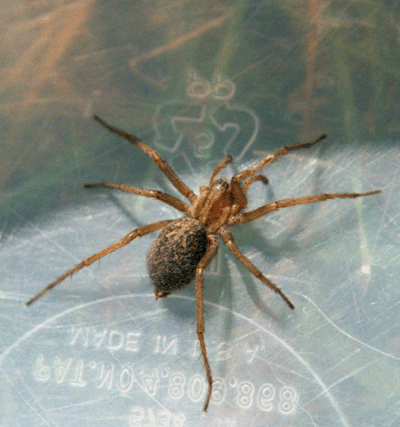 |
The hobo spider (Eratigena agrestis) is a common house
spider in Europe, where there is no history of
human envenomization. |
According to Colorado State University Extension entomologist, Whitney Cranshaw, "This is a... long overdue, but very welcome change. A large amount of scientific evidence had accumulated over the past 15 years that utterly refutes the claims of the original 1991 study that purported to make a link between slow healing wounds and the bites of this spider."
According to Cranshaw, over the past year the
American Arachnological Society and others have petitioned the CDC to remove hobo spider from its web page.
Sometimes referred to as the aggressive house spider, the hobo spider is a European import that has established itself over the past century in the Pacific Northwest, from Washington to Colorado. Following a flurry of publicity in the early 1990s, it was thought to be an explanation for brown recluse like symptoms sometimes reported from this part of the country, where brown recluse is not found. This information even found its way into some pest control guide books.
Despite fears in the U.S. the spider has no history of association with necrotic bites in Europe, and repeated experimentation in recent years could not replicate skin lesions supposedly associated with its bite.
Cranshaw bemoans the fact that it will still be a long time before all the hobo spider misinformation on the Internet fades, but in the meantime you and your customers can sleep a little easier. There is one less pest to worry about.
For more information
Anyone who wishes to look into this issue in more depth may be interested in this b
ibliography compiled by Dr. Whitney Cranshaw, Colorado State University, of articles concerning Eratigena agrestis as a medically important spider.
Original articles suggesting Eratigena (formerly known as Tegenaria) agrestis is a medically important species
- Akre, R. D., and E. A. Myhre. 1991. Biology and medical importance of the aggressive house spider,Tegenaria agrestis, in the Pacific Northwest (Arachinida: Araneae: Agelenidae). Melanderia 47: 1–30.
- Vest, D. K. 1987a. Necrotic arachnidism in the northwest United States and its probable relationship toTegenaria agrestis (Walckenaer) spiders. Toxicon 25: 175–184.
- Vest, D. K. 1987b. Short communications envenomation by Tegenaria agrestis (Walckenaer) spiders in rabbits. Toxicon 25: 221–224.
- Vest, D. K. 1993. Differential diagnoses of necrotic arachnidism in the northwestern United States. Am. Arachnol. Soc. 48: 10 (Abstr.).
- Vest, D. K. 1996. Necrotic arachnidism-Pacific Northwest, 1988–1996. J. Am. Med. Assoc. 275:1870–1871.
Articles refuting the purported association of Eratigena (=Tegenaria) agrestis as a source of necrotic arachnidism (skin disfiguring spider bites)
- Binford G.J. 2001. An analysis of geographic and intersexual chemical variation in venoms of the spider Tegenaria agrestis (Agelenidae). Toxicon, 39:955-968.
- Vetter R.S., Roe A.H., Bennett R.G., et al. 2003. Distribution of the medically-implicated hobo spider (Araneae: Agelenidae) and a benign congener, Tegenaria duellica, in the United States and Canada. Journal of Medical Entomology, 40:159-164.
- Vetter R.S. 2004. Causes of Necrotic Wounds other than Brown Recluse Spider Bites. University of California Riverside. http://spiders.ucr.edu/necrotic.html. Last accessed August 19, 2011.
- Vetter R.S. and Isbister G.K. 2004. Do Hobo Spider Bites Cause Dermonecrotic Injuries? Annals of Emergency Medicine. December, 44:6.
- Melissa M. Gaver-Wainwright, Richard S. Zack, Matthew J. Foradori,3and Laura Corley Lavine. 2011. Misdiagnosis of Spider Bites: Bacterial Associates, Mechanical Pathogen Transfer, and Hemolytic Potential of Venom from the Hobo Spider,Tegenaria agrestis (Araneae: Agelenidae) . Journal of Medical Entomology 48(2):382-388. doi: http://dx.doi.org/10.1603/ME09224
- Bennett, R. G. 2002. Hyperbole and hysteria on the path to enlightenment: a review of current Tegenaria projects of relevance to Canadian arachnologists. Can. Arachnol. Newsl. 4–10.
- Bennett, R. G. 2004. An approach to spider bites: erroneous attribution of dermonecrotic lesions to brown recluse or hobo spider bites in Canada. Can. Fain. Physician 50: 1098–1101.
- Benoit, R., and J. R. Suchard. 2006. Necrotic skin lesions: spider bite—or something else? Consultant 46: 1386–1394.
- Bettini, S., and P. M. Brignnoli. 1978. Review of the spider families, with notes on the lesser known poisonous forms. In S. Bettinik (ed.), Arthropod Venoms, Handbook of Experimental Pharmacology. Springer-Verlang,Berlin, Germany.
- Isbister, G. K. 2004. Necrotic arachnidism: the mythology of a modern plague. J. Lancet 364: 549–553.
- Vetter, R. S., and G. K. Isbister. 2004. Do hobo spider bites cause dermonecrotic injuries? Ann. Emerg. Med. 44: 605– 607.
- Vetter, R. S., and G. K. Isbister. 2008. Medical aspects of spider bites. Annu. Rev. Entomol. 53: 409–429.