Thursday, July 18, 2013

ACE program considers certification for turf and ornamental professionals

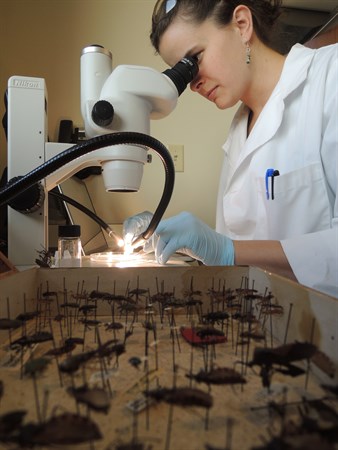
Since 2004 the Entomological Society of America has offered a certification program for professionals in the pest control industry.  The Associate Certified Entomologist (ACE) - Pest Control program currently has 623 ACEs-Pest Control and is offering new services and growing every month.

Insects that feed on trees, like this cottonwood borer, are among
 the pests that an ACE-Turf & Ornamentals would be expert in.
Now ESA is announcing its interest in starting a new certification for turf and ornamental professionals. The effort is just getting underway, according to a letter from the current Certification Board Director-Elect, Pat Copps, with Orkin. According to Copps, the "ESA is in the process of gathering market information to possibly expand the ACE-Pest Control program."

If the Board determines that there is sufficient interest, "a similar certification and set of requirements would be developed for Turf and Ornamental professionals. The program would build on the foundation of the existing ACE certification and when complete would be managed by the ESA Director of Certification with the assistance of the ACE oversight committee."

Insects are important pests of turfgrass and ornamental plants, and insect control is an essential component of landscape maintenance.  Having certified professionals, well trained and knowledgeable about these pests and about safe management practices, could go a long way toward making outdoor pest management safer for people and the environment.

If you think this sounds like a good idea, ESA would like to hear from you. Interested persons should contact Chris Stelzig, ESA Director of Certification, cstelzig@entsoc.org.  Ideas and comments are welcome at this time.

This is a busy summer for the Certification Program under Stelzig's guidance. Canadian readers may be interested to know that ESA is developing an ACE pest control certification for Canadian entomologists.  And the ACE-Pest Control exam is undergoing review and updating this summer.  A new exam, with many new questions, should be ready in a couple of months.

Wednesday, July 17, 2013

Cedar oil or Snake oil? Control claims disputed.

Manufacturers who claim to control insects
affecting human health, like this head louse,
must be properly registered and have data
 that shows efficacy against the target pest.
The company claimed that their bed bug and head lice insecticide was invented by the U.S. Army, and acknowledged by the USDA as the number one choice of "bio-based" pesticides. The company also claimed that the U.S. EPA was warning consumers to avoid "chemical solutions" for treating bed bugs. The problem was that the company's claims weren't true.

As a result of false claims and illegal marketing of untested products for bed bugs and head lice, yesterday the Federal Trade Commission issued a judgment and settlement with a Texas-based manufacturer of cedar oil based insecticides. This action was a follow-up to charges filed last fall against another manufacturer of an unproven bed bug treatment containing cedar, cinnamon, lemon grass, peppermint and clove oils.

So what's so bad about making dubious insect control  claims for a supposedly "safe" product like cedar oil? After all, the U.S. EPA has frequently let the market determine which products really are effective against many pests.  And if the product really is "safe", what's the harm of promoting it and letting consumers figure out whether it works or not? We know that cedar oil does have effectiveness against some pests, like many other essential oils.

Historically regulators have drawn a line in the sand, and rightly so, for products that claim to control bed bugs, mosquitoes, head lice or other pests affecting human health. If you think you are protecting your or your children's health by using a product, the federal government has long taken the stance that you have a right to be reasonably sure that the product should work as advertised.

While the FTC cautions consumers about advertisements that offer quick solutions to bed bug infestations, this is a problem that affects professionals as well. Even professionals are prone to be duped by false or overblown marketing claims.  Consider this: if it were easy to control bed bugs with a do-it-yourself product why would people continue to need your professional services?  And look around.  Are your competitors finding bed bug control easy? There is still no "silver bullet" for bed bugs.

What's missing from many marketing claims is scientific research involving replication and untreated controls. And it makes sense that a company selling a product for such uses should be able to produce research results that justify their sales claims. So if you're considering investing in a new bed bug insecticide for your home or business, here are some questions to ask:

  • Is the product registered with the U.S. EPA as a bed bug (or head louse or mosquito, etc.) insecticide?  
  • If a manufacturer claims their product to be exempt from EPA registration, is the company also making claims that their product protects humans from pests that can harm human health?  If so, they may not be qualified to be exempted from label requirements. For the rules concerning exempt pesticides, and a list of active ingredients that really are exempt under the 25(b) provision of FIFRA, go to http://www.epa.gov/oppbppd1/biopesticides/regtools/25b_list.htm 
  • What is the toxicology profile of the product?  Just because a product is natural doesn't mean it's safe. Ask to see the Safety Data Sheet and find out whether the product has been tested by the EPA.
  • Can the manufacture produce data from an unbiased testing laboratory to show the efficacy of their product?  Do the data include comparisons with untreated controls, and were tests replicated and shown to be statistically significant?
  • Does this data show that both susceptible and pesticide-resistant strains are killed?  This is especially important for bed bugs.  I've seen some products tested only against bed bug strains that are known to be highly susceptible to most insecticides (e.g., the bed bug 'Harlan strain'). Such products may not perform as well against tough field strains that your technicians are most likely to encounter.
  • Does the product have to be sprayed directly on the pest, or is there data to show that exposure to dried residues will also kill the pest?  If residual testing was conducted, how long was the pest exposed to the residue?  Is this exposure time realistic for the bed bug populations you are treating?
  • Does the data show that the product kills eggs as well as nymphs and adults?  Again, this is especially important for bed bugs.
  • How well does the product perform compared to other standard pesticides being used for the pest?
And if your customer asks you about why they need your services when they can buy "Kilz Em Safe" online or at the local garden store, it might pay to point them to the FTC's warning against products that promise a quick solution.  Remind them that when they hire you, they're paying for more than insecticide.  Every good pesticide applicator knows that it's not just a natural insecticide that will get the job done safely.  It's the knowledge of where and how to safely apply a good insecticide that's important.

Wednesday, June 19, 2013

Kissing bugs get some love

Rachel Curtis at Texas A&M University studies
Chagas disease eco-epidemiology.
.
One of the odder, and a little scary, pests that occasionally enter homes in Texas is the kissing bug, Triatoma species.  Kissing bugs aren't very good kissers, but they get their name from their habit of biting sleeping humans on the face at night.  Even worse, the "kiss" of the kissing bug can sometimes bring with it a parasite, Trypanosoma cruzi, that causes Chagas' disease.

If you are a blood donor you may have heard of Chagas' disease.  It's one of those mysterious illnesses you get asked about before you give blood. Thankfully, it's not thought to be common in the U.S., but is a very prevalent in some parts of Central and South America.  Recently there has been growing concern that Chagas' disease may be becoming more common in the U.S., and that it's occurrence might be underestimated.

A research team at Texas A&M University is beginning to study the different kissing bugs in Texas.  They hope to learn more about where kissing bugs are active, where different species are found, what hosts they prefer, and how often the parasite infects the bugs.

 Triatoma kissing bug are 1/2 to one inch-long.
If you come across a kissing bug, the Hamer Labs team would be interested in getting samples. It's important not to touch the kissing bug (they could be carrying germs and they can bite), but scoop it up in a small container or plastic bag.  If the bug is collected in a client's home, advise them to clean any surfaces that the bug may have crawled on with a disinfectant cleaner. If you find a kissing bug and want to donate it to the project, they ask that you first contact them via the email address kissingbug@cvm.tamu.edu. They will provide you with specifics on how and where to send.

For a brochure about the project, go to http://vetmed.tamu.edu/media/513063/kissing%20bug%20brochure.pdf

Tuesday, June 18, 2013

TDA announces new penalty guidelines

It would be nice if we all would be motivated to do the right thing solely by the promises of good things (carrots!).  But in reality most of us need painful consequences (the proverbial stick!) to keep us consistently honest.  That's the reason for the new Texas Department of Agriculture (TDA) penalty matrix.

On June 14 the TDA and the Structural Pest Control Service published new penalty guidelines and a penalty matrix (table) for companies in violation of pest control rules and regulations.  The TDA has always worked from a table of penalties, though the industry rarely saw it.  The new penalty guidelines and tables are an attempt to make the process more transparent to your business and the public.

Because these are not new rules or regulations, the penalty matrix does not require public input, though the TDA has indicated that it will accept and consider comments and recommendations. Draft versions of the matrix were previously shown to the Texas Pest Control Association and the Structural Pest Control Advisory Committee, and comments were incorporated into the final draft published last week. The matrix will go into effect July 1.

As a member of the Advisory Committee I hear comment from many of you concerning enforcement of rules.  I know one of the major concerns by conscientious applicators around the state is that penalties be significant, yet fair and consistently enforced.  The new matrix does involve increases in some fines, and is designed to encourage more consistency in penalty assessment over the previous matrix.

The table allows the TDA some freedom in determining the exact fine, and a fine may be higher that indicated on the table depending on intent of the violator and consequences of the violation.  I encourage everyone with a structural pest control business to become familiar with the matrix, and review it with employees this summer as a reminder that the carrot is always better than the stick.


Carabid invasion

Harpalus, ground beetle, carabid beetle
These inch-long beetles in the genus Harpalus are the latest insect
Texas plague to hit homes, businesses and schools.
The insect of the week, at least in east Texas, is a carabid beetle in the genus Harpalus. 

Ground beetles are fast-moving, predators that, as the name implies, forage on the ground. Outdoors they and their likewise predaceous larvae are found on the ground in all habitats, both grassy and forested areas.

Ground beetles have little interest in coming indoors, where there is little food. However they may accidentally enter homes or businesses when they slip under doors in their escape from daylight. Outdoors they hide under rocks, leaves, logs, etc. during the daylight hours.

Most ground beetles are relatively strong fliers and will be readily attracted to lights during their nocturnal mating flights. Typically these flights occur once a year over a one or two week period.

The current flurry of calls about what one inquirer called those “crunchy black beetles” is likely the result of a recent mating swarm. The current ground beetle invasion will be short-lived, but other species of ground beetles, like the caterpillar hunter, may be evident at other times of year. None of these species pose any real harm to people or pets (some have large enough jaws to bite if you pick them up), and they do help feed the birds.

No chemical control should be necessary for ground beetles. Beetles that are drawn into lights are either (1) going to be eaten by birds or other predators, or (2) going to fly away the next evening.  The best advice you can give customers who don’t like having all those crunchy beetles around, is to consider turning off the outdoor lighting around the account for part or all of the night. This should be necessary for only a week or so, until the flights subside.

If a customer insists on some control action, be aware of the recent label changes for pyrethroid insecticides. New pyrethroid labels do not allow application to concrete surfaces that will be exposed to rain. This would include sidewalks around buildings, and sides of buildings over concrete that not protected by eaves or canopies from the rain. Granular baits designed for crickets or cockroaches will not be effective against these predatory beetles.  For more information about ground beetles, the University of Kentucky has published a nice summary.

Thursday, June 13, 2013

New bed bug publication

If you've ever performed a bed bug control job you know it's not something you get exactly right the first time. Bed bug control requires knowledge of the pest, knowledge of the technologies available to control the pest, experience looking for the pest, and lots of muscle memory.
The new bed bug publication from Texas
A&M AgriLife Extension packs lot of tips
and information into 7 pages. Download it
free online.

If you've paid your dues, learned the routine, and think you've gotten pretty good at bed bugs, don't you wish prospective clients would recognize that?  Well now there's a new publication that might help.  How to Select a Bed Bug Provider (ENTO-033) is the latest entomology fact sheet from Texas A&M AgriLife Extension.  

By leading the reader through the different treatment approaches, and suggesting how to interview a prospective pest control company, this publication is designed to match bed bug sufferers to the best PMP.  Sections include:
  • What to look for in a pest control company
  • Approaches to bed bug control
  • Preparation
  • Warranties and follow-up
  • Cost
  • Bagging tips
  • Special considerations for apartment managers
In addition, we've included an interview card to help the user objectively compare you to other bidders. Criteria include experience, technician training and support, preparation requirements, good communication, monitoring, professionalism, warranty and follow-up.  

If you're really good at bed bug control, chances are that this guide will prospective customers see that. Maybe it should have a place among your sales material for future bed bug jobs. 


Tuesday, June 11, 2013

Voles, Moles and Pocket Gopher training

Vole.  Image courtesy the Play-Wright Flyer Guy blog.
Stephen Vantassel, Wildlife Damage Project Coordinator at the University of Nebraska, recently held a webinar covering management of voles, moles and pocket gophers.  Fortunately, thanks to the modern technology of webinar playback, the presentation is saved online so that you can view the information at your leisure.

The thing I appreciate most about Stephen's presentation is his emphasis on wildlife IPM.  Listening to the presentation I was particularly gratified to hear that wildlife management specialists have the same frustration as entomologists when it comes to IPM. The first question that I almost always get about an insect pest is "what's the best spray to kill it?" The reason this question is frustrating is that management of any pest is much more about understanding the pest, and about habitat modification.  IPM is not just about what chemical or special trap to use, its about correcting the conditions that lead to the pest problem.

So if you have interest in voles, moles or pocket gophers, check out this presentation when you have an extra 50 minutes. You'll get a good overview of an IPM approach to these three important landscape pests.