 |
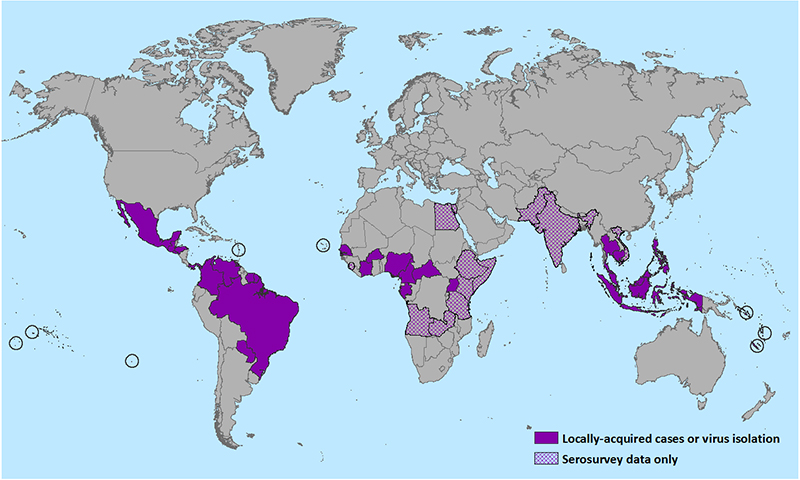
| Current (2015) worldwide range of zika virus. Central and South American countries were first reported with the disease in 2015 (U.S. Centers for Disease Control). |
Now health officials are bracing for another mosquito-borne disease caused by Zika virus (abbreviated ZIKV by epidemiologists). A cousin of west Nile virus and dengue fever, ZIKV has been thought of as a less severe form of these flavivirus. Most people who get ZIKV show no, or very mild symptoms. Others exhibit a rash, conjunctivitis (inflammation of the eye), and flu-like symptoms. Most people do not get as sick with ZIKV as with dengue fever or chikungunya, and recover relatively quickly.
For this reason, since its discovery in 1947 until 2007, it was not on the radar of many public health experts. But in 2007 ZIKV cases started to spread throughout Micronesia French Polynesia, and eventually Easter Island. There it was thought to possibly be the cause of a twenty-fold increase in cases of Guillain-Barre syndrome--an autoimmune disease of the central nervous system that can be highly disabling, at least temporarily.
In 2015 the disease made its appearance in Brazil and has since spread to at least nine other member states of the Pan-American Health Organization (PAHO/WHO), and prompting that organization this month to issue an alert to all of member public health agencies.
So here's where things get a little scary. Since the arrival of ZIKV to Brazil, the virus has been detected in babies born with a condition known as microcephaly. Microcephaly is a relatively rare condition where the brain fails to develop normally. It may result in miscarriage or in babies being born with under-sized brains. There is no cure for the condition. The PAHO/WHO alert noted that the number of diagnosed cases of microcephaly has increased to 2700, a 10-fold increase, in Brazil this year. Health officials there are worried that there might be a connection between this unprecedented increase in microcephaly and the arrival of ZIKV. And last month, unusual nervous system birth defects were also reported in Polynesian mothers who tested positive for flavivirus antibodies.
Public health officials guess that these cases may result when a pregnant woman who is bitten by an infected mosquito contracts the virus. The virus then infects the developing fetus, resulting in this serious condition.
So far there is no hard proof of a connection between ZIKV and microcephaly or Guillain-Barre syndrome, but medical researchers are rushing to learn more about the virus and its possible effects on human health. According to one expert, quoted in the New York Times, it could be that the risk of microcephaly is increased among people who have previously contracted dengue fever or chikungunya, neither of which diseases are common to Texas or the U.S. If this hypothesis proves correct, the risks to the unborn in this country would likely be negligible.
Currently, ZIKV is thought to be transmitted by the yellow fever mosquito, Aedes aegypti. This mosquito, along with its close relative, Aedes albopictus, the Asian tiger mosquito, are both very common throughout Texas and the southern U.S. Unlike west Nile virus, which is primarily a disease of birds, ZIKV is solely a disease of primates. To be spread among people, it must be picked up from another infected human.
Dengue and chikungunya are similar, human-only, viruses that have not been quick to spread in Texas or other U.S. locations. This may be the result of lower rates of mosquito biting in the U.S., perhaps due to our more indoor lifestyles, or more common use of repellents. Some experts argue that for similar reasons ZIKV is likely to be slow to establish in the U.S. Nevertheless, Brazil shows that given the right conditions, this virus is capable of establishing itself very rapidly, with 85,000 known infections in its first year of spread.
A few U.S. cases of ZIKV have been reported in 2015, but all from travelers who contracted the virus elsewhere. Mexico has also seen a few cases this year. There are still no known cases of ZIKV, however, contracted within the U.S.
So be prepared to hear more about the zika virus this year. It may turn out to be a big event, or it may not. Even if we didn't need more reasons to dislike biting mosquitoes, now we have one more reminder of the importance of residential mosquito control, and putting on the insect repellent when venturing outdoors.


