Showing posts with label ZIKV. Show all posts

Thursday, July 14, 2016

West Nile virus risk high in north Texas

Residual insecticides applied via backpack mist blower
sprayer can provide 3-4 weeks of mosquito control  during
times of peak mosquito activity.
July and August are typically the months of highest risk from west Nile virus, and true to form the past few weeks Dallas and Tarrant counties have seen a major increase in not only mosquitoes themselves, but infections within the mosquitoes.

After the major outbreak of WNV in 2012 in north Texas, some health officials made a decision to use something called the Vector Index (VI) as a form of threshold to ramp up mosquito control efforts.  Based on when human cases started to soar in 2012, and on suggestion from the CDC, a VI of 0.5 was determined to be a good threshold to consider going from ground based spray efforts to aerial spraying.

Two weeks ago the VI exceeded that threshold in both Dallas and Tarrant counties.  Both counties publish very interesting reports, available to the public, that include graphs to show  the latest mosquito counts and VI numbers.  To see the trends in Dallas and Fort Worth areas, check out the graphs below.  In the first graph, the Vector Index is the heavy red line.  Last week it exceeded the 0.50 threshold, although there was a drop this week. Note also the numbers of mosquitoes this summer (red bars) compared to average trap catches in 2012 (for the past four weeks, higher than 2012 averages shown by the blue bars). In Tarrant County (Fort Worth and surrounding communities) the VI (green line with triangle points) was likewise up last week, over 0.60 (new data is not yet published).  Note that the most recent 1-2 data points are preliminary estimates and may change as all the data is calculated.


These data are why there is discussion about aerial spraying this week.  In 2012 the number of human cases of WNV in Dallas county reached almost 400, and there were 19 deaths attributed to WNV. Serious business. Last week DCHHS issued a health advisory to the public, and this week the Dallas County commissioners voted to authorize the health department to prepare for possible aerial spray operations should conditions warrant.  

Where does all this leave the PMP who provides residential mosquito control service?  Municipal mosquito spraying actually complements, rather than replaces, mosquito control work on the ground done by professionals.  Aerial spraying generally provides better coverage of the tree canopy where WNV carrying mosquitoes (Culex quinquefasciatus in north Texas) live and mostly feed. Municipal truck mounted ULV sprays provide some control of lower level mosquitoes (Aedes mosquitoes that potentially transmit Zika and dengue fever, among other diseases), but they typically do not provide high level control in backyards or areas protected from spray coverage.  In that sense, the best control of Aedes mosquitoes is accomplished by your boots on the ground, looking for and treating or eliminating mosquito breeding sites, treating doorways, and treating shrubbery and other mosquito resting sites that are difficult to reach from the street.

As you and your technicians visit mosquito control customers this summer, keep in mind that you carry some of the most effective tools in the war against mosquitoes.  This summer, with Zika fears and WNV threats, what you do is more important than ever.

Tuesday, December 29, 2015

Bracing for Zika

Will Zika be the next mosquito-borne disease to capture headlines in 2016?  Or will it be the little disease that few (at least in the U.S.) have heard of?  That's the question being debated by public health officials this year.

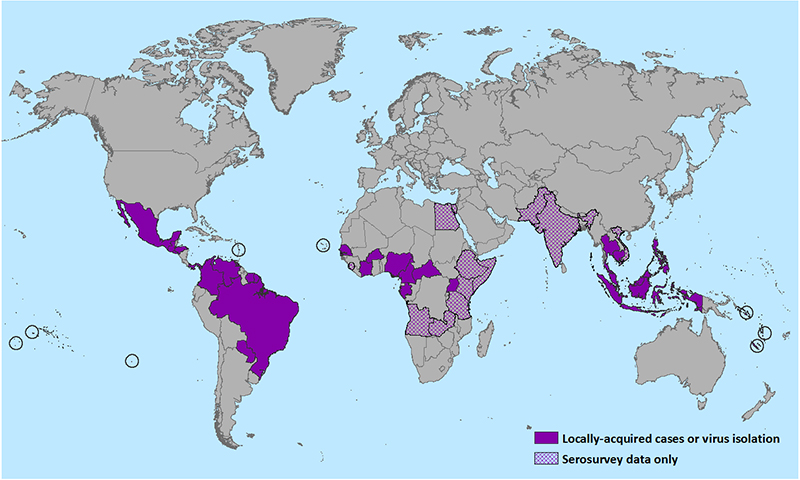
Current (2015) worldwide range of zika virus. Central and South
American countries were first reported with the disease in
2015 (U.S. Centers for Disease Control).
For many years it seemed like new things happened relatively slowly in public health in Texas. In the mid-1980s entomologists reported the Asian tiger mosquito in Texas for the first time--a daytime-flying mosquito from Japan that is not shy about biting humans. Then in 2002 the first cases of west Nile virus hit our state.  Carried by the southern house mosquito, WNV affected a couple of hundred people or less each year. This was the case until the blazing hot summer of 2012 when over 1800 cases were reported, including 83 deaths. Health departments throughout the state are still reeling, in some ways, from the impact.

Now health officials are bracing for another mosquito-borne disease caused by Zika virus (abbreviated ZIKV by epidemiologists).  A cousin of west Nile virus and dengue fever, ZIKV has been thought of as a less severe form of these flavivirus.  Most people who get ZIKV show no, or very mild symptoms.  Others exhibit a rash, conjunctivitis (inflammation of the eye), and flu-like symptoms.  Most people do not get as sick with ZIKV as with dengue fever or chikungunya, and recover relatively quickly.

For this reason, since its discovery in 1947 until 2007, it was not on the radar of many public health experts. But in 2007 ZIKV cases started to spread throughout Micronesia French Polynesia, and eventually Easter Island. There it was thought to possibly be the cause of a twenty-fold increase in cases of Guillain-Barre syndrome--an autoimmune disease of the central nervous system that can be highly disabling, at least temporarily.

In 2015 the disease made its appearance in Brazil and has since spread to at least nine other member states of the Pan-American Health Organization (PAHO/WHO), and prompting that organization this month to issue an alert to all of member public health agencies.

So here's where things get a little scary.  Since the arrival of ZIKV to Brazil, the virus has been detected in babies born with a condition known as microcephaly.  Microcephaly is a relatively rare condition where the brain fails to develop normally. It may result in miscarriage or in babies being born with under-sized brains.  There is no cure for the condition.  The PAHO/WHO alert noted that the number of diagnosed cases of microcephaly has increased to 2700, a 10-fold increase, in Brazil this year.  Health officials there are worried that there might be a connection between this unprecedented increase in microcephaly and the arrival of ZIKV.  And last month, unusual nervous system birth defects were also reported in Polynesian mothers who tested positive for flavivirus antibodies.

Public health officials guess that these cases may result when a pregnant woman who is bitten by an infected mosquito contracts the virus.  The virus then infects the developing fetus, resulting in this serious condition.

So far there is no hard proof of a connection between ZIKV and microcephaly or Guillain-Barre syndrome, but medical researchers are rushing to learn more about the virus and its possible effects on human health.  According to one expert, quoted in the New York Times, it could be that the risk of microcephaly is increased among people who have previously contracted dengue fever or chikungunya, neither of which diseases are common to Texas or the U.S. If this hypothesis proves correct, the risks to the unborn in this country would likely be negligible.

Currently, ZIKV is thought to be transmitted by the yellow fever mosquito, Aedes aegypti.  This mosquito, along with its close relative, Aedes albopictus, the Asian tiger mosquito, are both very common throughout Texas and the southern U.S.  Unlike west Nile virus, which is primarily a disease of birds, ZIKV is solely a disease of primates.  To be spread among people, it must be picked up from another infected human.

Dengue and chikungunya are similar, human-only, viruses that have not been quick to spread in Texas or other U.S. locations.  This may be the result of lower rates of mosquito biting in the U.S., perhaps due to our more indoor lifestyles, or more common use of repellents.  Some experts argue that for similar reasons ZIKV is likely to be slow to establish in the U.S.  Nevertheless, Brazil shows that given the right conditions, this virus is capable of establishing itself very rapidly, with 85,000 known infections in its first year of spread.

A few U.S. cases of ZIKV have been reported in 2015, but all from travelers who contracted the virus elsewhere.  Mexico has also seen a few cases this year.  There are still no known cases of ZIKV, however, contracted within the U.S.

So be prepared to hear more about the zika virus this year.  It may turn out to be a big event, or it may not.  Even if we didn't need more reasons to dislike biting mosquitoes, now we have one more reminder of the importance of residential mosquito control, and putting on the insect repellent when venturing outdoors.