 |
| One of the first bed bugs we discovered was this well-fed adult on the mattress seam. |
It turned out to be more than a couple of bed bugs. She had a full blown infestation.
Over the years my children have mostly just tolerated, if not ignored, my entomological passions. But this daughter is no slouch. She knew a few things about bed bugs. Like many people it just never occurred to her that bed bugs could happen to her.
The bites she'd started to notice in the morning? Probably mosquitoes. The little red spots on the bedding? Probably from the mosquito bites. It wasn't till she saw two bed bugs frolicking on the sheets at night that it finally clicked..."Of course! How dense can I be? My dad taught me better than that!" (I added that last part)
 |
| Small blood spots on sheets are easily dismissed by someone not familiar with bed bugs. Blood spots are a more sure diagnostic sign of bed bugs than just "bites". |
Of course my daughter's first concern was where to sleep. As with all of us, ignorance is bliss. The night before her discovery it was OK to sleep in her infested bed. But now that she knew her bed was crawling with unwanted vampire bugs, it just wasn't the place for a restful sleep. I can't say I blamed her.
It's times like these that both she and I appreciated the availability of a pest control professional at the other end of the phone. In her case, the landlord was supportive and had a pest control company ready to come out and treat her apartment. The problem was, what to do in the meantime.
In general it's not a good idea to abandon one's bed as a solution to bed bugs. The problem is that once you start sleeping on the couch, it's just a matter of time before the bed bugs figure out where supper has moved and you end up with bed bugs in another room of the home. But for at least one night I counseled her to sleep on the couch and I would be over the next day to help.
 |
| A dis-infested bed ready for clean sheets is now a relative oasis from bed bugs until the PMP arrives. |
To make a long story short, daughter returned to sleep in her own bed that night, and after a month reports no more bed bugs. Of course the PMP arrived the next day and undoubtedly deserves much of the credit for successfully keeping the infestation from spreading; but the experience taught me several things that I will take with me as I advise clients with similar problems. I hope these thoughts will also help you too as you deal with frantic customers:
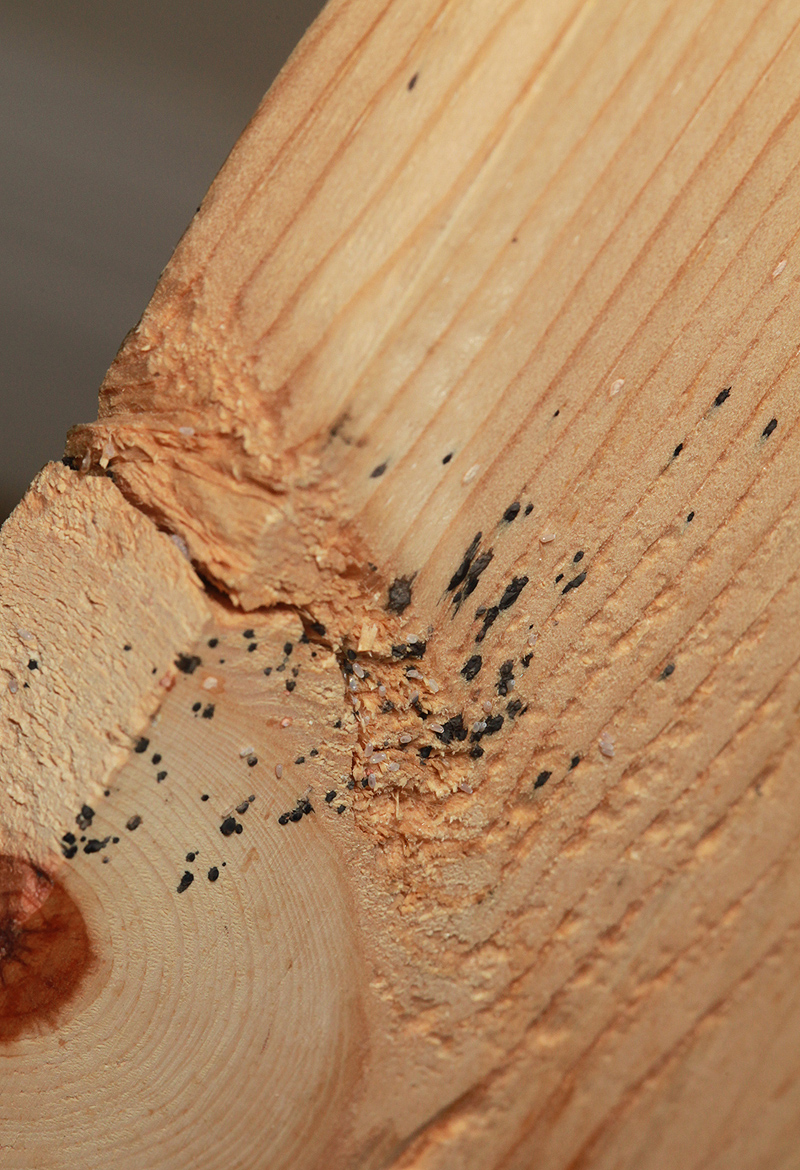 |
| Bed bugs prefer laying eggs on rough surfaces, like this bed slat. I initially photographed this wood because of the fecal droppings, but later counted at least 28 eggs in this image alone. Double-click the image and see how many you can find. |
- Don't think that just because a customer has an advanced case of bed bugs that they willfully allowed the situation to progress. Many people experience mild to zero reactions to bed bug bites, and have no idea that they are feeding dozens to hundreds of bed bugs. A recent, informal study of Orkin employee reactions to bed bug bites reported by Ron Harrison at the NCUE found that less than one in 20 people showed any noticeable reaction to bed bug bites.
- Because many people think bed bugs will never happen to them, they tend to overlook bed bug clues that, in retrospect, are obvious.
- Customers need guidance in how to survive the waiting period between bed bug discovery and when service can be provided. I know that many of you respond to bed bug calls with next day service, but inevitably there will be customers who will have to wait two or more days. Providing landlords with a variety of sizes of mattress encasements, Climbup® or similar traps for bed posts, and vacuuming instructions ahead of time can help renters survive the agonizing wait for service. By creating an oasis of safety in the midst of an infested apartment, you allow the customer a chance to sleep comfortably in their own bed without running the risk of spreading bed bugs to other parts of the apartment or home.
- Remind your regular customers about the signs of bed bugs. The earlier an infestation is caught, the better the chances of bringing it under control quickly.
- Use bed post interceptors wherever feasible. Even after treatment these devices provide you and the customer with a sensitive way to monitor the effectiveness of control. In my daughter's case, not all bed bugs were killed with the initial treatment, as evidenced by several more bed bugs being caught in the Climbup® cups in the succeeding weeks.
- Plywood beds or rough wooden bed slats are especially favored places for bed bugs to lay eggs. Study of closeup photographs of the wooden slats on my daughter's bed after I treated showed me dozens of eggs I didn't see on inspection. Even though these slats were treated by me and by the PMP with insecticide and steam, we opted to remove the slats (they weren't necessary for supporting the box spring anyway) afterwards.
- While I recommend bed bug-proof encasements as a less expensive (and more effective) alternative to throwing away infested mattresses and boxsprings, throwing away plywood bed stands or other types of rough wooden beds might be a good idea for some customers. Replacing such beds with a metal, or smoothly finished wooden four post bed, or an inexpensive metal bed frame on wheels, will allow you to create a safe, bed bug oasis even in the midst of a bed room that still harbors live bed bugs.
- Our industry needs better, more detailed explanations for customers on how to treat bagged clothing and personal items. My daughter didn't receive very helpful information about what to do with all her "junk" once it had been bagged in preparation for service. Even the PMP had few, helpful suggestions on what to do with personal items other than "wash everything". But more on that in a later blog.
My final, take-home lesson in all this is to not loan your bed and mattress to anyone. Even if your dad's an entomologist.


