Showing posts with label bed bug. Show all posts

Wednesday, November 27, 2019

Society meeting highlights risks of ignoring science

We ignore science, including the study of insects, at our own peril.  This was an underlying message in session after session of the 2019 Annual Conference of the Entomological Society of America.

This year's ESA conference, just a few minutes' walk from the iconic St. Louis Arch, was my first business visit to the the city where I spent most of my growing up years. Out for a jog on the first day of the meeting I remembered as a kid watching workers fit last shiny aluminum triangle into place at the top of the Arch shortly after my family arrived. I admit I felt a little old when I realized the Arch turned 55 this year.

Glorious flies

As glorious as technology can appear to the human eye, I was quickly reminded that insects are just as cool, and have been around a lot longer than any arch.  The plenary session speaker was Janet McAlister, British author of the book The Secret Life of Flies.  With a generous dash of humor, McAlister breezed through story after story of amazing flies.  One in ten living species on the planet is a fly, she said, with 17 million individual flies for every living human. Flies are also beautiful when you get close enough.

We can thank the fruit fly, Drosophila melanogaster, a pest of kitchens and hospitals around the country, for its contributions to our modern understanding of genetics and the genes associated with diseases like Alzheimer's and Parkinson's.

Flies are important pollinators too. A type of biting midge is also the sole pollinator of Theobroma cacao, our plant source for chocolate. No flies?  No more chocolate.

And as McAlister pointed out, at times even crime fighters depend on flies.  The first murder solved with the assistance of insects was the strange case of  Dr. Buck Ruxton in England in 1935. Ruxton was convicted of murdering his wife and servant after the fly maggots found in his victims' decaying bodies were used to estimate the approximate time of the murder.  And as any fan of television's CSI shows will tell you, flies are used for the same purpose today. For some fantastic images of flies, check out Gil Wizen's photography page (featured in many of McAlister's slides).

The coming Insect Apocalypse?

It's not too often that I see reference made to the Bible in a scientific paper, much less a meeting; but this year's buzz-phrase for many attendees was "insect apocalypse."  One of the better attended symposia was devoted to Insect Decline in the Anthropocene (the Anthropocene is a scientific term for the man-dominated biological/geological era we are in today).  While I missed several talks in this session while darting between papers, the central message was clear.  Something is happening to insect populations around the world, and it's not good.

Among concerns of attendees are declines in many kinds of
wild bees, sometimes referred to as a "Beepocalypse"
Hans deKroon, from Radboud University in the Netherlands reported on the results of a 27 year study of insect densities in 63 German nature preserves.  Using the same sampling method and places for sampling in relatively unchanged parklands between 1989 and 2016, the researchers documented a 76% decline in the total weight of insects (biomass) caught in traps over this time.  The surprising thing was that declines were seen across all sites with all kinds of insects--not just a few.  The authors attribute some of the decline to land fragmentation (sites were often close to agricultural land), but also possibly pesticides and climate change.

David Wagner, University of Connecticut, reported a similar 70% decline in moths of pristine New England forests.  The decline, he said, averages 1-2% per year and is across a large region.  The only explanation is some kind of broad external cause(s). Beyond increasing global temperatures, possible causes for loss of moths and butterflies include nitrification, light pollution, exotic insects, and car strikes.

So what are the consequences of such large declines in insect biomass?  I mean shouldn't we be rejoicing in fewer insects if this means fewer pests?  Absolutely not. In addition to entomologists, all sorts of biologists and nature lovers should be concerned by these numbers. Insects are keystone (ecologically very important) species in many environments.  They help decompose dead organic matter, keep potentially invasive plants under control, and feed fish and birds and many, many other types of wildlife. Indeed, one especially depressing study in the Science journal this year reports a 29% decline in bird numbers in the U.S. since 1970 (click here to see the paper in full). While the reasons for bird decline are complex, losing an important food source is not good for birds or bird lovers.

Tim Showalter, Louisiana State University, cautioned attendees to take care in drawing hasty conclusions, and in careless interpretation of apocalyptic data.  In a cautionary paper, he noted that a 2018 paper on supposed food chain collapse and a 60% decline in insect populations due to climate change in a Puerto Rican rain-forest garnered attention in the press, but was ultimately based on faulty data.  A change in positioning of temperature stations, misinterpretation of different survey databases, and impacts of multiple hurricanes led the authors to erroneous conclusions.  The food chain is NOT collapsing in Luquillo, Puerto Rico, he said. A rebuttal to the paper is now posted on the journal website.

Showalter's paper illustrates the imperfection, yet self-correcting nature of science.  It also illustrates how easy it can be for interpreters of science to cherry-pick data to reinforce a given point of view. We all need to be critical readers of science; however, this doesn't mean we can't trust scientists.  Certainly the majority view of entomologists is that something alarming is happening to many kinds of insects in many locations around the world. We should not ignore this issue or the scientists raising fair warning.

Learning from History

Rocky Mountain locust, Melanoplus
spretus, ca. 1870s, Minnesota. 
As I get older, history gets more interesting.  The ESA is fortunate to have among its membership a significant number of scientists with an interest in the historical roots of entomology. For example, I learned from Jeffrey Lockwood, University of Wyoming, that the first recorded time our government called on science to solve a political problem involved entomology. Between 1874 and 1877 the Rocky Mountain locust caused staggering crop damage in Kansas, Nebraska, Minnesota and Missouri. While inventors and hucksters of the day promoted a variety of solutions for locusts, little was really known about the biology and life cycles of these insects. For example, many farmers believed that locusts were so diabolically destructive because they were led by kings and queens (not true).

In 1876 a new governmental group known as the Entomological Commission was authorized by Congress to study the problem. The team quickly recognized that the key to the locust's destruction lay in identifying its true identity, its breeding grounds and the conditions that led to outbreaks (sounds a lot like an IPM program).  Also a collection of natural enemies was identified. While this information would have ultimately been useful in developing long-term control measures, Rocky Mountain locust swarms were already in decline by 1877--something for which the entomologists were happy to take credit. It turns out that by the 1880s the swarms all but ceased, likely because of the loss of the great buffalo herds which, by reducing food in the permanent breeding range, and pulverizing the soil with their hooves, would trigger the buildup of migratory locust swarms.

Entomologists were pragmatists in the locust wars, arguing against those who ascribed the swarms as evidence of God's judgement due to a general lack of morality and repentance.  Rather than promoting a day of prayer, however, entomologists insisted that farmers would be better served by looking to science to discover the causes and solutions to the plagues.  Today the Rocky Mountain locust is extinct, following the path of all organisms that cannot adapt to a changing environment.

Insects and Health

Like it or not insects are important factors in human health. Insects and indoor health was the theme of one session I attended.  Respected researcher Felicia Rabito, Tulane University, pointed out that asthma remains relatively poorly understood, despite its public health significance. One in 12 children in the U.S. suffer from asthma, a chronic inflammatory disease of the airways. In her studies 73% of homes have elevated levels of one or more environmental triggers of asthma (e.g., smoke, pet dander, particulate air pollution, and pest derived allergens).  Cockroach allergens remain one of the strongest promoters and triggers, and appear to cause four times the hospitalization rate of other allergens. Her research with a relatively small sample size showed that even a single IPM intervention (bait only) could have significant positive health outcomes for kids living in treated homes. Their team plans to redo the study with a larger (300 household) sample size.

A co-researcher with Rabito, and one of the most original and thought-provoking urban entomologists today, Coby Schal, North Carolina State University, gave an interesting talk on reducing cockroach allergens simply through cockroaches baiting.  He argued that the comprehensive IPM approach, such as advocated by the National Institute of Allergy and Infectious Disease, starting with improving sanitation, use of non-chemical tactics, biological control and (perhaps) chemical control may be too slow and expensive in most cockroach infested homes (think public housing).  His data suggests that IPM and health specialists should lead with cockroach baiting because it is the fastest and least expensive way to reduce indoor allergens. It remains alarming to me the number of pest control companies that still rely primarily on sprays to control German cockroaches, when baits have time and again been shown more effective in controlling cockroaches and improving public health.

Bed bugs remain a topic of interest in these meetings, though not to the level of 5-10 years ago.  Jonathan Sheele gave two papers on bed bugs from a doctor's perspective. In the Ohio Emergency Room where he previously worked, he noted that when bed bugs were found on a patient, that room would be out of use for cleaning and pest control an average of 20 hours. This would happen every 2-3 days on average. His hospital spent $30,000 annually on IPM costs associated with infested patients. Patients with bed bugs were more likely to suffer anemia, Staphylococcus infection, and use an inhaler than patients without bed bugs. In a separate paper, Sheele reflected on the potential for a future pill that people could take to kill bed bugs. In lab studies, both spinosad and fluralaner (Bravecta®) provided excellent control of bed bugs; however neither drug is yet approved for use on humans.  Abamectin is another antiparasitic agent that does have human approval, however tests on its effectiveness in humans against bed bugs have not been conducted. Such an innovation could be a big boon, especially for low income families suffering from bed bugs.

Stephane Perron, National Institute of Public Health in Quebec, Canada, looked at bed bugs in public health and reported that bed bug infestations often result in prolonged stress for patients. Some of the mental health impacts of bed bugs include fear, sense of lack of control, physical discomfort, sleep deprivation, financial stress, property loss, stress over preparing a home for treatment, conflicts with neighbors, the stigma associated with bed bugs, fear of insecticides, and exacerbation of prior mental health issues.  On the flip side, a recent study she conducted showed that anxiety and depression could decline when bed bugs were successfully controlled--a real benefit pest management companies can take pride in.

Zach DeVries, University of Kentucky, noted that the bed bug's status as only "a nuisance" is coming to an end. Again, public health professionals, decision makers and politicians need to take cockroaches, bed bugs, mosquitoes and other urban pests seriously.

Odds and Ends

Again I felt a little old during this meeting when I realized how different students are today. Grad students at the meeting are more diverse and more attuned to social media than ever before. As such they represent many of your younger pest control customers.

Striving to keep up, I attended a session on using social media.  I found myself in a group fellow laggards who did not understand some of the basics of the Twitter platform.  While I do use Twitter (@mikemerchant), I realized I still didn't understand some of the basics of the app and Twitter platform.  I learned how to better use hashtags, and that I need to follow more people if I want to expand my personal Twitterverse (I have a difficult-enough time with the regular Universe) #oldfashioned, #luddite, #booklover.  I reflected that if we fail to learn from these young professionals we risk ending up like the Rocky Mountain locust.

Joe DeMark, Corteva AgriScience, gave a paper on a new termiticide caulk formulation in the works. The caulk provides another above-ground option for treating termite tubes.  It could, I envision, replace the somewhat clunky (though effective) AG bait stations.  Caulk has an advantage of being flexible enough to inject into infested trees, or placed directly on an exposed termite foraging tube.  It has the same active ingredient as Sentricon, noviflumuron and is applied with a regular caulk gun.  In studies conducted in New Orleans against Formosan termites, tree infestations were consistently eliminated in about 2.5 months.  Control of termites in homes was accomplished in 30-90 days.  If it should ever become a product, DeMark does not expect it to be commercially available until after 2020.

The Asian longhorn tick is now present in 11 states since its discovery in 2017.  A first human bite was recorded this year, which was significant because of its ability in other countries to carry disease to both livestock and humans.  In a talk by Ryan Smith, Iowa State University, I learned that a 2019 study showed that the tick could pick up Lyme disease from an infected mouse (bad). But the same study showed it could not maintain the disease through molting. This is good news, because it means this tick is unlikely to transmit Lyme disease in the wild.  Nevertheless, there are other diseases of concern and the increasing number of exotic pests being introduced into the U.S. continues to threaten both ecological and human health

Lastly, the ACE Associate Certified Entomologist program hosted by the ESA continues to grow. As of this writing there are 1251 active ACEs.  ESA estimates that there will be 1,272 ACEs by the end of year (lots of new applicants currently), representing 13.5% growth since December last year. The ACE program is unique in that it is the only individual-oriented certification program. It can provide potential customers with assurance that your company has qualified staff, and allows you to attend meetings like the St. Louis conference at discounted rates.

If you think you're interested in becoming an ACE, check out the ESA Certification Corporation website.  And consider attending one of the upcoming Texas prep classes in Dallas or in College Station.  The class is an excellent way to either begin studying, or as a last-minute confidence builder before taking the test.

Each of us has a unique role to play in service to our society. But we only do our jobs well when we commit ourselves to lifelong learning. As is clear from these meetings, knowledge is expanding rapidly.  I hope each of you keep following the science behind the pest control profession (as you already are by reading to the end of this post) and continue to avoid the perils of unfounded opinion.

Science is the father of knowledge, but opinion breeds ignorance. Hippocrates


Friday, August 5, 2016

Comparing dusts for bed bug control

For several years PMPs have known that dusts can be useful tools in the management of bed bugs, but a new paper in the Journal of Economic Entomology by Narinderpal Singh and colleagues at Rutgers University shows just how powerful they can be.

Singh et al. used four different lab assays and two strains of bed bugs to probe the efficacy of eight insecticide dusts.  Each assay showed a different aspect of how these dusts perform.  Together, I think, they do a pretty good job of evaluating how you can reasonably expect these products to perform in the real world.

Four experimental assays used to study the toxicity of
various dusts and predict their effectiveness in the field.
Clockwise from upper left (1) brief exposure assay, (2)
choice assay, (3) assay where CimeXa-treated bugs are
allowed to mingle with untreated bugs, and (4) continual
exposure assay with treated paper . (Singh et al. 2015,
J. Econ. Entomol.)
One of the problems with doing lab assays is that they can be highly unrealistic.  Sure, you can put an insect on a treated surface and watch them until they die (a continuous exposure assay).  Certainly this kind of assay can tell you whether there is potential for a product to work; but in a customer's home do your bed bugs have nothing better to do but sit on the insecticides you put out?  Probably not.

More often than not in the real world, insects run quickly across an insecticide barrier and then spend most of their time resting on untreated surfaces. Insecticide exposure may be only a matter of seconds. At other times, insects that move back to a treated harborage may be able to sense when they are on insecticide residues.  They may then choose to move to a clean spot that has not been sprayed or dusted (a sign of repellency).  Continuous exposure assays may overestimate the effectiveness of insecticide applications, especially when applications do not reach key harborage areas, or when residues are repellent to the pest.

On the flip side, insects may inadvertently pick up insecticide residue from a treated surface and carry that insecticide on their cuticle back to a harborage area. When this occurs they may transfer it via contact to other bed bugs clustered in the same harborage.  Failure to account for this in lab assays might end up underestimating the effectiveness of your treatment.  

Singh and colleagues tried to account for all of these possibilities in their research. One assay required the bugs to sit on treated paper for the length of the study.  A second assay had the bed bugs walk across a treated one-inch barrier.  And a third test gave the bugs the choice to visit and rest on either dust-treated or untreated surfaces.
Bed bug dusts included in the trial were Tempo, DeltaDust, Cynoff, Pyganic, EcoPCO D.X, Alpine, MotherEarth, and CimeXa. 

As you might expect, all products killed bed bugs when they sat continuously on the treated surfaces. After five days there was 100% mortality for all bed bugs in the treated dishes. When bed bugs were allowed to choose freely to rest on either treated and untreated surfaces, CimeXa and Tempo gave 80-95% control after one day; however after 10 days MotherEarth (diatomaceous earth) and Cynoff were close behind.  

The clear champion of the toughest test, the brief exposure test, was CimeXa Dust. CimeXa provided 95-100% mortality (at 1 and 10 days after exposure) to bed bugs crossing a one inch barrier of the dust.  Tempo was the next most effective product in the brief exposure trial, providing 40-60% mortality against the two bed bug strains. This ability to kill bed bugs with very short contact can be a game changer. It suggests that CimeXa may be capable of providing decent barrier protection on bed and furniture legs, in dressers or even along door thresholds (though unprotected deposits will likely be quickly rubbed or swept away). 

Singh and his team then went on to see whether CimeXa might also have the ability to transfer from exposed to unexposed bed bugs. It did. Clean bed bugs, that had not been previously exposed to CimeXa, when placed with CimeXa-treated bugs also had significantly higher (80-100%) mortality after 10 days compared to untreated controls.

Singh's work backs up previous work done by Mike Potter's lab in Kentucky.  Potter's group found that CimeXa was more effective than liquid Temprid residues against resistant bed bug strains in continuous exposure assays. He also found that as a stand alone treatment in infested apartments it provided rapid and marked control, superior to diatomaceous earth, and similar to that provided by the top liquid insecticide sprays. 

What these studies tell me is that insecticide dusts should definitely be part of your bed bug control program, especially in accounts with insecticide resistant bed bugs.  Silica aerogel, the active ingredient in CimeXa, performed better than the other commonly used desiccant (MotherEarth, i.e., diatomaceous earth), and even out performed the other pyrethroid dusts.  It should be noted, however, in settings where harborages can be fully dusted, these other products may still provide good control. And laboratory tests cannot fully duplicate what happens in the field--your real world accounts.

But my real reason to single out this study is that it provides a true low-risk option for bed bug control.  Because the mode of action of desiccant dusts is based on abrading the cuticle of the insect, and not on any mechanism that would potentially affect human health, it's a no-brainer to make these products a mainstay of your dust arsenal.  Used inside furniture, behind drawers and baseboards, in cracks and crevices of bed frames, these products make excellent, safe to use, treatments. Even if heat treatment is your tactic of choice, insecticide dusts can provide a long-term supplemental treatment to kill any bed bugs that might re-infest an apartment, hotel room or other bed room.

If dusts are not an important part of your chemical or heat treatment protocols, you may be missing out on a relatively economical, effective and safe option to improve your success rate against these adaptable and tough-to-kill pests.  


Friday, September 26, 2014

Webinar makes learning about bed bugs easy


Do you service apartment complexes or other multifamily housing units?  Or are you a pest management professional with an apartment manager who needs to learn more about bed bugs? You and your customer might benefit from a recent webinar on bed bugs sponsored by the StopPests Now program for Multifamily Housing (yes, there really is such a group).

I think hindsight will show that multifamily housing, even more than hotels, has been ground zero for the current bed bug epidemic in this country. That's because apartment dwellers often lack the means to hire top notch bed bug control services, apartment management policies often discourage residents from reporting bed bugs early, many residents are limited in their ability to detect and correct bed bugs early, and the close quarters of apartments makes it easy for bed bugs to spread through high density housing. Add to that the high turnover rate of apartment dwellers with bed bugs, and the bed bug's excellent hitchhiking skills, and you have a spreading bed bug epidemic.

Webinar presenters, Dr. Dini Miller and entomologist Molly Stedfast, have been conducting research of bed bugs in multifamily housing for ten years.  They share results of this research, along with basic information about bed bugs that any PMP or apartment manager needs to know. Dr. Miller, especially, is a straight shooter who has strong words for apartment managers, in particular, those who would just as soon not have to deal with these difficult pests.

Don't let the hour and twenty minute run time deter you. Thanks to the fast talking presenters, this webinar doesn't drag, and has been edited to eliminate most of the down time associated with most webinars.  So kick back, grab a cold beverage and click on the video above. I think you'll find that the time you spend in this training well worth it.

Thursday, May 29, 2014

A bug by any other name...

A stink bug belongs to the suborder
Heteroptera and is an example of a
"true bug". All true bugs have piercing/
sucking mouthparts, and go through
a gradual form of metamorphosis.
Every student in their first college entomology class gets introduced to the major types of insects, among which is a relatively large group of insects known as heteropterans (formerly referred to as hemipterans). And any entomology professor worth their salt dutifully teaches every student the rule that heteropterans are the only insects that can be considered "true bugs". That's what I was taught, but like most of my fellow entomologists, I've never really known why. So today, when I was asked by a teacher...who had been asked by a 5th grader, I figured I needed to do some research. What I learned was interesting, and even has a very contemporary urban entomology connection.

In my experience Americans commonly use the term "bug" very loosely to mean any very small critter, insect or otherwise. In this way a spider can be referred to as a bug, or a pesky gnat as a bug. This doesn't bother me too much, but sometimes you sense a kind of superiority among some people who use the term "bug" this way. "I'll squash you like a bug!" Or, "It's just a buuug!"

And who in the industry has not been referred to as either "bug guy" or "bug lady" when showing up at a pest control account? Although I like bugs in general, and consider work associated with insects to be important and honorable, I never particularly cared for the name applied to my profession--perhaps because of the inferior connotations associated with bugs in many people's thinking.

It's interesting how language works on a word. The term bug has crept its way into a lot of other uses, including meaning germs that makes you sick, like the "flu-bug".  Or as the verb referring to the act of acting or being annoying, as in the complaint: "Stop bugging me!"

The first "real" computer "bug" is kept at the Smithsonian
National Museum of American History, though it is
not currently on display. 
Maybe one of the more interesting modern spin offs of the term bug comes from modern technology. Computer programmers often refer to a software problem as a "computer bug". Supposedly, the origin of this use of "bug" has historical roots in one of the earliest computer snafus (another word with an interesting WWII origin).  An early electro-mechanical computer, the Mark II, a predecessor of modern digital computers, stopped working one day and the problem was traced to a moth that had gotten stuck in a relay.

But how did the entomological form of the word bug get its start?  And why do entomologists get so hung up on folks who misuse the word to refer to something not technically a heteropteran?

It turns out that the term "bug" probably does have a semi-scientific origins connected to entomology. According to Carl Schaeffer, author of an article on heteropterans (Prosorrhyncha) in the Encyclopedia of Insects, the term "bug" comes from the old Middle English word bugge, which meant "spirit" or "ghost".  According to another favorite reference of mine, Roland Wilbur Brown's Composition of Scientific Words, the word may also be derived from the Welsh word bwg, for "hobgoblin", "spectre" or "sprite".  The word even shows up in some of Shakespeare's writings to refer to bogeymen or other terrifying forces.  Obviously the Welsh and the English were referring to the same thing... but what?

Were bed bugs the original bugge?
Shaeffer supposed that in earlier times when people woke up in the morning and discovered their skin covered in red itchy welts and blood on the bed, they naturally would assume that they had been visited by malevolent spirits, or bugges.  And as you've probably guessed, the welts experienced by sleepers in Merrie Olde England were not likely caused by wraiths or spirits, but by little flesh-and-blood insects that today we call bed bugs.  Presumably the more enlightened Englishmen and Welshmen quickly realized the true cause of nighttime welts and began referring to the insects themselves as bugges.  And eventually, by extension, all relatives of bed bugs were also called bugs--though entomologists apparently decided to keep their use of the term to only the bed bug relatives, today's heteropterans.

So bed bugs are most likely the original bugge, or bwg, according to Schaeffer. The next time you hear someone seem to dismissively refer to bugs, or the profession devoted to pest control, consider that for many bugs still remain a scary part of life. What entomologists and PMPs do is help keep the bugs and other pests out.  That's a worthwhile service and, not surprisingly, one people will always pay for. And as Shakespeare himself might have put it, "What's in a name? That which we call a bug, would it by any other name... drum up as much business?" Perhaps not.


Tuesday, July 3, 2012

A personal experience with bed bugs

One of the first bed bugs we discovered was this well-fed adult
on the mattress seam.
Last month, one of my daughters called me on the phone, panicked. "Dad, I think I've got bed bugs!"

It turned out to be more than a couple of bed bugs.  She had a full blown infestation.

Over the years my children have mostly just tolerated, if not ignored, my entomological passions. But this daughter is no slouch. She knew a few things about bed bugs. Like many people it just never occurred to her that bed bugs could happen to her.

The bites she'd started to notice in the morning? Probably mosquitoes.  The little red spots on the bedding? Probably from the mosquito bites. It wasn't till she saw two bed bugs frolicking on the sheets at night that it finally clicked..."Of course! How dense can I be? My dad taught me better than that!" (I added that last part)

Small blood spots on sheets are easily dismissed by someone
not familiar with bed bugs. Blood spots are a more sure
diagnostic sign of bed bugs than just "bites".
A visit to her apartment the next day revealed 200 to 300 bed bugs happily tucked away in the corners of the fitted sheets, dust ruffle and box spring cover of her bed.  We did some thinking back and concluded that we had probably introduced the bed bugs last February when she retrieved her mattress and box spring from a friend living in a (nice) uptown Dallas apartment.  She had loaned the bed to friend during a transition period when she was living at home after graduation.  I say "we" introduced the bed bugs because I helped her move the bed from friend's apartment to her new home in Fort Worth.  I didn't notice anything out of the ordinary at the time, but I wasn't really thinking bed bugs either.

Of course my daughter's first concern was where to sleep. As with all of us, ignorance is bliss. The night before her discovery it was OK to sleep in her infested bed. But now that she knew her bed was crawling with unwanted vampire bugs, it just wasn't the place for a restful sleep. I can't say I blamed her.

It's times like these that both she and I appreciated the availability of a pest control professional at the other end of the phone. In her case, the landlord was supportive and had a pest control company ready to come out and treat her apartment.  The problem was, what to do in the meantime.

In general it's not a good idea to abandon one's bed as a solution to bed bugs. The problem is that once you start sleeping on the couch, it's just a matter of time before the bed bugs figure out where supper has moved and you end up with bed bugs in another room of the home. But for at least one night I counseled her to sleep on the couch and I would be over the next day to help.

A dis-infested bed ready for clean sheets is now a
relative oasis from bed bugs until the PMP arrives. 
Because I wanted her to get back in her own bed as quickly as possible, we opted to make her bed safe while waiting for the professionals to arrive. With the generous help of friends at Target Specialty Products, I was quickly supplied with Mattress Safe® bed encasements, a set of Climbup® Bed Bug Interceptors, and a can of Zenprox® aerosol insecticide.  Vacuum at hand, we removed as many bed bugs as possible from the mattress, sheets and dust ruffle, box spring, and bed (At this point, long-suffering daughter had to put up with a dad who, every couple of minutes, had to stop and take closeup pictures to document the infestation--a small price to pay, I kept reminding her).  After slipping the mattress and box spring into their encasements, we continued vacuuming and tearing down the bed.  Once disassembled, I treated bed cracks and crevices with Zenprox, reassembled the bed and put Climbup® traps under the bed posts.  To keep anything from touching the floor, except the bed posts, we eliminated the dust ruffle.  All sheets and bedding were immediately stuffed into garbage bags and sealed tightly for transport to the laundry.

To make a long story short, daughter returned to sleep in her own bed that night, and after a month reports no more bed bugs. Of course the PMP arrived the next day and undoubtedly deserves much of the credit for  successfully keeping the infestation from spreading; but the experience taught me several things that I will take with me as I advise clients with similar problems.  I hope these thoughts will also help you too as you deal with frantic customers:

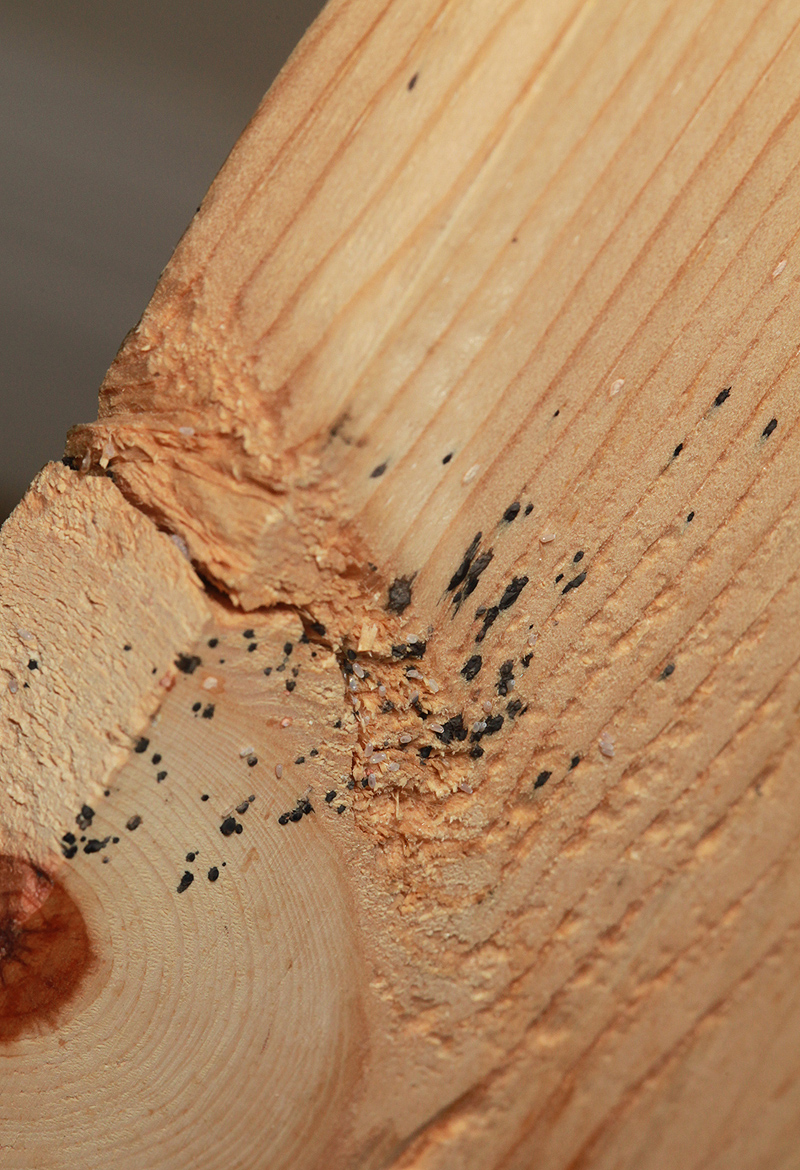
Bed bugs prefer laying eggs on rough
surfaces, like this bed slat. I initially
photographed this wood because of the
fecal droppings, but later counted at least
28 eggs in this image alone. Double-click
the image and see how many you can find.

  • Don't think that just because a customer has an advanced case of bed bugs that they willfully allowed the situation to progress.  Many people experience mild to zero reactions to bed bug bites, and have no idea that they are feeding dozens to hundreds of bed bugs. A recent, informal study of Orkin employee reactions to bed bug bites reported by Ron Harrison at the NCUE found that less than one in 20 people showed any noticeable reaction to bed bug bites. 
  • Because many people think bed bugs will never happen to them, they tend to overlook bed bug clues that, in retrospect, are obvious.
  • Customers need guidance in how to survive the waiting period between bed bug discovery and when service can be provided. I know that many of you respond to bed bug calls with next day service, but inevitably there will be customers who will have to wait two or more days.  Providing landlords with a variety of sizes of mattress encasements, Climbup® or similar traps for bed posts, and vacuuming instructions ahead of time can help renters survive the agonizing wait for service. By creating an oasis of safety in the midst of an infested apartment, you allow the customer a chance to sleep comfortably in their own bed without running the risk of spreading bed bugs to other parts of the apartment or home.
  • Remind your regular customers about the signs of bed bugs.  The earlier an infestation is caught, the better the chances of bringing it under control quickly.
  • Use bed post interceptors wherever feasible.  Even after treatment these devices provide you and the customer with a sensitive way to monitor the effectiveness of control. In my daughter's case, not all bed bugs were killed with the initial treatment, as evidenced by several more bed bugs being caught in the Climbup® cups in the succeeding weeks.
  • Plywood beds or rough wooden bed slats are especially favored places for bed bugs to lay eggs.  Study of closeup photographs of the wooden slats on my daughter's bed after I treated showed me  dozens of eggs I didn't see on inspection. Even though these slats were treated by me and by the PMP with insecticide and steam, we opted to remove the slats (they weren't necessary for supporting the box spring anyway) afterwards. 
  • While I recommend bed bug-proof encasements as a less expensive (and more effective) alternative to throwing away infested mattresses and boxsprings, throwing away plywood bed stands or other types of rough wooden beds might be a good idea for some customers. Replacing such beds with a metal, or smoothly finished wooden four post bed, or an inexpensive metal bed frame on wheels, will allow you to create a safe, bed bug oasis even in the midst of a bed room that still harbors live bed bugs.
  • Our industry needs better, more detailed explanations for customers on how to treat bagged clothing and personal items. My daughter didn't receive very helpful information about what to do with all her "junk" once it had been bagged in preparation for service.  Even the PMP had few, helpful suggestions on what to do with personal items other than "wash everything".  But more on that in a later blog.
My final, take-home lesson in all this is to not loan your bed and mattress to anyone.  Even if your dad's an entomologist.

Friday, March 9, 2012

Bed bug control in public housing

Last month the federal Department of Housing and Urban Development (HUD) published its official guidance for public housing authorities and managers of Section 8 (federally subsidized) housing.  If you do pest control work for public housing, you should be familiar with this new document.

Click here for the guidance notice PIH-2012-17 and here for guidance on prevention and safe removal of bed bugs.  Thanks to Allison Taisey and her blog on IPM in multifamily housing for this update.

Friday, October 21, 2011

How much would you pay for a bed bug?

Bed bugs (Photo by Bart Drees)
I was speaking with the Greater Tarrant County Pest Control Association (Fort Worth/Arlington) last night and we began discussing how much people pay for live insects.  My audience was amazed to learn that I will be paying more than $2 apiece for bed bugs for an upcoming project. I could see the wheels turning in every head, calculating "if I had $2 for every bed bug I've killed!" And I had to admit that getting paid for both removing and delivering bed bugs sounds like a pretty good deal in this tight economy.

My bed bug-requiring project is an insecticide trial; and I need insects of a certain life stage, of guaranteed health and known lineage to ensure that results are consistent and can be replicated.  Field caught bed bugs typically vary in age and life stage, and can be damaged during collection.  They also are more likely to be  genetically variable (making results more difficult to analyze), are of unknown pesticide susceptibility, and can not be easily re-collected by another researcher who might want to reproduce the results.  For these reasons, you can't just scoop up a few bed bugs and turn around and sell them on Craig's List (at least for research purposes).

It surprises most people to learn that there are a number of companies (called insectaries) that make money raising and selling live insects for something other than pet food or fish bait.  If you have a need for silverfish or cockroaches, cat fleas or house flies, chances are you can find a reputable seller (like my friend Bill Donahue's Sierra Research Labs) of these and other pest species.  Bed bugs are reared not only for research labs, but also to keep canine handlers supplied with fresh bed bugs for bed bug sniffing dogs.

In addition to pest insects, there are dozens of "beneficial insectaries" that sell beneficial insects for use in biological control programs.  They are represented by a trade group called the Association of Natural Biocontrol Producers.  Most of the insects produced by ANBP member companies are probably of little use to PMPs unless your company also controls insect pests of interiorscapes (indoor live plants) or greenhouses, where biological control has proven most effective.  One biological control agent exception is for cockroach parasites, especially tiny parasitic wasps that control brown banded cockroaches. Beneficial nematodes are another example of a non-insect predator that can control some difficult to control soil inhabiting pests like fungus gnats (to give an indoor example).

Finally, consider the butterfly rearing business.  There are a growing number of people who rear butterflies for profit. A few weeks ago I paid a visit, with an eager class of master volunteers learning about insects, to a small business in the Dallas area called Butterflies Unlimited.  Owner Dale Clark explained that the butterfly business is still growing as public and private gardens, museums, and even weddings are incorporating butterfly releases into their events.

There appears to be a lesson for all of us in this. There's more than one way to make a living off of insects.


Thursday, May 12, 2011

Do bed bugs carry disease?

A study just published in the CDC journal, Emerging Infectious Diseases, looks at the question of whether bed bugs might be vectors (carriers) of antibiotic-resistant bacteria.  In scientific parlance this is a great example of a Q&D study (quick and dirty).  The Vancouver, BC researchers had three hospitalized patients come in with bed bugs on their persons.  They thought, "wouldn't it be interesting to test these bed bugs to see if they have any antibiotic-resistant pathogens?"  So they took the bed bugs, crushed them up, and tried to isolate bacteria from them.

It turned out that two of the patients had one bed bug each that tested positive for vancomycin-resistant Enterococcus faecium (VRE).  The third patient had three bed bugs that tested positive for methocillin-resistant Staphylococcus aureus (MRSA).  The authors speculated that the bed bugs may have picked up these bacteria from the low-income community where the patients were from (infections from the two bacteria are prevalent there).  They also hypothesized that bed bugs in this community could be acting as a hidden environmental reservoir for MRSA, and could be contributing to the spread and amplification of MRSA infections in these impoverished and overcrowded communities. 

Such speculations and hypotheses are useful for researchers who love to make guesses and then test their hypotheses through further observations and experiments.  But it is important for those of us in the pest management field to not confuse speculation and hypothesis with facts.  Vector biologists can cite many examples of pests that have been shown to harbor a pathogen, but are not considered to be infectious to humans.  The standard of proof is pretty high for stating that a given insect or animal is capable of spreading infection.  This test does not meet that burden of proof by a mile.  And the authors would be the first to admit it.

So have bed bugs been shown to carry human disease?  Not yet.  In a clinical review published in the Journal of the American Medical Association, entomologist Jerome Goddard and medical doctor Richard deShazo combed the medical literature and could find no strong evidence showing bed bugs to be disease carriers. Based on collections from bed bugs, the hepatitis B virus (HBV) may be the best candidate for human disease transmission by bed bugs; however in an African study, a two-year eradication program that achieved 100% control of bed bugs had no effect on HBV infection rates. The authors concluded that "Although transmission of more than 40 human diseases has been attributed to bed bugs, there is little evidence that they are vectors of communicable disease." 

This is not to say that bed bugs lack health implications for humans.  Goddard and deShazo describe the most common reaction to bed bug bites as "2- to 5-mm pruritic maculopapular, erythematous lesions", medical terminology for "red itchy spots".  These spots usually itch and, "if not abraded, resolve within a week."  Some people, however, have more complex reactions to the bites including rashes and secondary infections.  Also, some people develop severe allergic reactions after multiple exposures to the bites (interestingly, in a 1985 experimental study cited in this review, only 30% of a volunteer cohort showed any reaction to bed bug bites).

In a joint statement issued last year, the Centers for Disease Control and the U.S. Environmental Protection Agency pointed out the emerging health implications of our growing bed bug problem.  In it they addressed the impact that bed bugs can have on mental health, saying, "Bed bugs may also affect the mental health of people living in infested homes. Reported effects include anxiety, insomnia and systemic reactions."  This aspect of the bed bug problem needs more study, and seems to be poorly appreciated by many in the hospitality and pest control industries.

When addressing the medical importance of bed bugs to your customers, it's important to look at the whole picture.  Bed bugs are a public health issue, even though they are not known at present to carry any disease pathogens. It would be unethical to imply that bed bugs are carriers of disease at this time; but at the same time bed bug elimination is important work.  Effective control of bed bugs alleviates anxiety, insomnia and discomfort for your clientele, and maintains a sanitary environment in which to live.  Isn't that what the pest control profession is all about?

Tuesday, March 29, 2011

Bed bug or bedbug

Last week, while reviewing an article in which I was quoted, I commented about the spelling of bed bug.  The article writer was using the condensed (one word) form of the name and I argued that it should be two words. This is consistent, I said, with the way other insect compound names are handled. The editor thanked me for my input and said they would "look into it".

I suspect I know what that means.  The lumpers seem to be winning these days over the splitters, as you will see if you read Jodi Dorsch's editorial in today's PCT magazine.  Jodi tackles the "bedbug" vs. "bed bug" issue and comes out strongly in favor of "bed bug".  She notes the arguments of at least one blogger, Michael Quinion, as the opposing point of view. I agree with Jodi's stance and applaud her efforts. 

The traditional rule that I (and I believe most entomologists) learned for spelling insect names goes like this.  Bed bugs are true “bugs” in the insect order Hemiptera. Typically when an insect name accurately identifies the order to which it belongs, it is spelled as two words (e.g., house fly). But when the insect common name includes an inaccurate descriptor of the insect order, it is spelled as a single word (e.g., dragonfly, which is not a true fly, but it’s own order). Check it out and you'll see this rule is pretty consistent for insect common names (e.g., whitefly, inchworm, cutworm, billbug--none of which are true flies, worms or bugs).

I take some offense to Quinion's statement that "the [one word] spelling has long since become standard for everybody except professional entomologists."  Hey, wait a minute.  Who, besides entomologists wrote about, or even cared about, bed bugs until bed bugs became hip a year or three ago?  And with any kind of professional word, since when does one not look to professionals for guidance with spelling?  If I want to know the proper spelling or pronunciation of a Macpherson strut, I ask a car mechanic. If I'm writing about a cerebrovascular accident (aka stroke) I check my spelling with a medical dictionary. So it would follow that if someone is writing about insects, you would consult with an entomologist. Quinion dismisses any rules (substantiated by the official common names of insects guidelines published by the Entomological Society of America) as a quaint form of "folk entomology".  Excuse me?  I think I'll go have a cerebrovascular accident.

Monday, January 31, 2011

New NPMA document on bed bugs worth a read

Last week the National Pest Management Association released a document outlining what their panel of experts have determined to be "best management practices" (BMPs) for bed bug control.  If you're interested in bed bugs and think this might make for some interesting reading, guess again. 

Sadly, the NPMA Bed Bugs best management booklet will not be making Oprah's Book of the Month list anytime soon.  The information is in outline form, similar to (yaaawn) bullets in a PowerPoint presentation.  Nevertheless, this is an important read for all technical directors and anyone overseeing a professional bed bug control operation.  Given the leadership role played by NPMA in this industry, the book will be as close to an authoritative guide to bed bug management as you will find.  It will also likely be looked to as a standard by lawyers and others pursuing PMPs for failure to control bed bugs. 

Don't expect any juicy pest control gossip, like what are the best insecticides for killing bed bugs.  Instead, you'll find general principles such as "always read and follow all label instructions when applying insecticides..." and "Choose products labeled for the target site."  There is a checklist of sorts for the places that should be treated, which might be useful in developing your own in-house treatment protocols.  In fact, the document could be used as a guideline to help develop a training program for your technicians.

The two appendices are also worth checking out.  If you have ever considered adding a canine bed bug detector to your company, Appendix A lists minimum standards for certifying a canine detection team (dog + handler).  I believe standards of this nature will become critical for consumers, and any pest management company considering investing in a dog team would be risking a lot by not following an accepted standard for training.  Appendix B provides a listing of research-based exposure times for bed bug heat treatment, important for anyone using heat in bed bug control programs.

Who said learning had to be fun anyway?

Friday, January 21, 2011

Ohio's request for potent bed bug insecticide denied, again

For some reason, Ohio has been one of the hardest hit states with bed bugs. Even the governor has gotten involved, petitioning the EPA last year for a special exemption to allow the use of an older carbamate insecticide, propoxur, for bed bug control.  This exemption, also called a Section 18 Emergency Exemption after the FIFRA section that authorizes it, is something that EPA does not give out easily.

Propoxur, as it turns out, is still pretty effective against bed bugs.  In Australia, for example, PMPs regard one of the propoxur-containing products as most effective.  In another study using presumably resistant bed bugs from Sri Lanka, propoxur provided the best control compared to DDT and malathion.

Much to the dismay of Ohioans, their Section 18 request was turned down last summer.  The EPA was asked to reconsider, and in a letter dated January 11 Lisa Jackson, the EPA Administrator, responded.  In her letter Jackson denied the use of existing stocks for bed bug control, and steadfastly maintains that her agency believes the product poses an unacceptable risk for children.

In an interesting concession, Jackson told the governor that EPA would consider allowing the use of propoxur in senior residences, where the risk of exposure to children would be minimal: 
As I explained in my June 2010 letter to you, EPA cannot grant Ohio's broad request because the Agency's risk assessment indicates an unacceptable risk to children . Nonetheless, I committed the Agency to work with Ohio and others to identify comprehensive alternative approaches to address bed bug infestations . As we also discussed in September 2010, EPA is willing to allow the emergency use of propoxur in senior residences in ways that would ensure children are not exposed. EPA staff has discussed this proposal with Ohio officials and have asked them to submit a revised request reflecting this proposal, but Ohio has not yet done so. We continue to hope the state will submit a revised Section 18 request to help provide relief to a highly impacted population.

She also noted that EPA is reviewing new data that might affect the way EPA determines how much exposure to propoxur or other insecticides that children might receive as a result of crack and crevice applications.  So the door is still open for EPA to backtrack should political pressure trump science, as it sometimes does.

Maybe the saddest part of this story is that, according to governmental authority, children don't visit grandma anymore.

Monday, October 11, 2010

A closer look at bed bug resistance

An interesting story came out last month from the National Evolutionary Synthesis Center at U.C. Berkeley.  The story does a nice job of explaining the connection between DDT and pyrethroid resistance, and why pyrethroid resistance has appeared to develop so quickly in the short time that bed bugs have re-emerged as an important North American pest (The one bone I have to pick with the story is its confusion of the relationship and terminology between pyrethrins and pyrethroids--there is no such term as "pyrethrums").

The answer is that when bed bugs reemerged this decade as a major pest they had already been "pre-selected" for resistance to pyrethroids by their previous exposure to DDT.  Because DDT acts at a similar site in the nervous system as pyrethroids, researchers theorize that the same mutations that conferred resistance to DDT bestowed protection upon the bearers of those mutations from pyrethroids. 

I remember John Osmun, one of my professors at Purdue University, recounting with excitement one of his early army adventures with bed bugs.  As an entomologist with the military in the early 1940s he had been assigned to use a secret insecticide to treat bed bug infested army barracks.  Almost miraculously, the long-persisting infestation was eradicated.  The insecticide was, of course, DDT.  Since WWII, DDT went on to become a widely used tool to manage many insect populations, including bed bugs.  Unfortunately bed bugs have used their long experience with this insecticide to fight back against more advanced pesticides.

A recent study by Zhu et al (2010) looked at bed bugs collected from 97 locations in 17 states and found resistance to deltamethrin in 88% of the sites.  Because of the scattered geographical sampling conducted in this study, the status of bed bug resistance in Texas is still tentative.  The only sample from Texas collected and analyzed in this study was from Beaumont, and showed resistance based on one genetic mutation.  Many of the samples revealed populations with another genetic mutation, or even two mutations. Relatively few populations sampled were classified as fully susceptible to deltamethrin.

This does not mean that resistant bed bugs cannot be killed with deltamethrin or similar products; but it does mean that the dose needed to kill will be greatly increased.

The research, especially the resistance maps of the U.S., should be considered tentative; but does give us a better idea why bed bugs are so difficult to control with standard pyrethroid insecticides.  Even though the study focused on deltamethrin only, the results should be mostly applicable to all pyrethroids.  Chlorfenapyr is the only other liquid residual insecticide that is widely used at the present time that is not a pyrethroid insecticide and to which bed bugs have no known resistance. 

Monday, August 2, 2010

Bed bugs in the news

Adult bed bug.
Two news items of interest (to me) with respect to bed bugs appeared this week.  The first is a report by NPMA in cooperation with the University of Kentucky that documents increases in bed bug problems worldwide, and not just in the U.S.  This is interesting because up till now there has been little information about what is going on with bed bugs outside our country. The survey contacted approximately 1000 PMP respondents about their experiences with bed bug problems.  Prior to the Year 2000 only 25% of U.S. PMPs had encountered this pest.  As of 2010, 95% of U.S. respondents have encountered bed bugs in their daily business.

New York City may be ground zero for bed bugs.  According to an Associated Press story released this week, bed bugs were included last year for the first time in a citywide community health survey.  More than 6% of respondents reported having battled bed bugs in the past year.  That's a lot of people with bed bugs. What's more, New York is directing $500,000 in city health department budget to battling bed bugs.  Believe me, you can buy a bunch of entomologists with that kind of money.

Friday, March 26, 2010

PCT article and request for feedback on use of bed bug traps

Check out the PCT magazine version of the bedbug research I posted about last month from Rutgers University. One nice thing about this version of the article is that it shows pictures of the bed bug interceptor traps in use.  To my knowledge this is the first reported successful use of unbaited Climbup® interceptor traps being used to monitor bed bugs. 

Click image to view article
94 95
Understanding Bed Bug Infestation And Dispersal Patterns

I'm curious how many of you have used these types of traps and whether and how well they have worked for you.  If you have experience with monitoring/inspecting for bed bugs, would you consider answering a few questions about your experience? If so, click here to go to a brief Survey Money questionnaire. I will publish results shortly.

Thursday, March 18, 2010

National bed bug survey seeks your input

Passing on the following worthwhile information from Liza J. Fleeson with the Virginia Department of Agriculture:

"The National Pest Management Association (NPMA), in conjunction with the University of Kentucky, is interested in developing a better understanding about the re-emergence of bed bugs across the United States. To that effect, NPMA has asked that we reach out to the pest control industry and encourage you and your fellow pest management professionals to complete a voluntary on-line survey on this issue. The link to the US Bed Bug Survey is posted on our website at www.vdacs.virginia.gov/pesticides. The results will be published in a future issue of the PestWorld newsletter. The survey will run through March 22, 2010 but please consider completing it at your earliest convenience.

"Thank you for your participation. Should you have any questions, please do not hesitate to contact Jeffrey Rogers, Environmental Program Planner, OPS, at jeffrey.rogers@vdacs.virginia.gov or 804-371-6561."

This kind of information helps the entire pest control industry, so even if you're not an NPMA member or don't have bed bug woes now, please take a few minutes to respond. In a few years you may be dealing with bed bugs big time and your current experiences will make a nice contrast with today's answers.  Note: the survey is for PMPs only.

Wednesday, March 3, 2010

Guidelines for killing bed bugs in laundry

The nice thing about an emergency pest problem, like the current bed bug epidemic, is that such problems attract a lot of attention from the research community.  A few weeks ago I reported new research from the Wang laboratory at Rutgers University on some interesting facts about bed bug infestations in high rise apartments. In the same journal two British scientists from the University of Sheffield, R. A. Naylor and C. J. Boase, report on another aspect of bed bug management...how to kill bed bugs in bedding and clothing using laundering procedures.

Knowing how to dis-infest clothing is important to pest control, because, as the authors so carefully explain, bedbugs "may seek harborage among clothing stored close to the bed, or may be entangled with bed linen while it is being changed. "  And, "once associated with clothing or linen, there is a risk that bed bugs may then escape insecticide treatments, and may be transported to new locations."

Although there have been many recommendations on the Internet and in print concerning how to dis-infest laundry, Naylor and Boase point out that such recommendations are often vague or conflicting and have been based on little formal research.  So they set out to look at the temperatures and conditions necessary to ensure 100% mortality of adult, nymph and egg stages of bed bugs.

To do this they took laboratory reared bed bugs and sealed them in cotton bags.  These bags were then placed among sheets or in the pockets of clothing to assess mortality of standard cleaning methods.   The results were enlightening and should help in recommendations for how your customers can ensure maximum effectiveness of methods to disinfest household articles.

A summary of the results of this study include the following:
  • Freezing can kill bed bugs.  Reducing temperatures to -17 degrees C (0 degrees F) for 2 hours will kill all bed bug life stages (about the temperature of a chest freezer, not a refrigerator freezer).  A 5.5 lb batch of clothes, however, does not drop to 0 degrees F immediately.  The researchers found that it took about 8 hours for the temperature in the center of that wad of clothes to killing temperature.  Upshot?  Put clothes in freezer for at least 10-12 hours.
  • Bed bugs are also susceptible to high temperatures of 40-50 degrees C (104-122 degrees F).  In order to reach these temperatures, clothing to be dis-infested can be placed in a large tumble drier at the HOT setting for at least 30 minutes (for a 7.7 lb load).  A 10 minute HOT tumble dry only killed about 75% of nymphal bed bugs, 85% of adults.  Interestingly, the COOL cycle killed almost no bed bugs.
  • Soaking clothes in cold water for 24 hours (without detergent) killed all adults and nymphs, but killed no eggs. Unfortunately, the researchers did not test whether soaking clothes in cold soapy water for 24 hours would kill eggs.  This alternative treatment might be useful, especially for cleaning clothes that are labeled for cool wash and dry only.
  • Dry cleaning killed all life stages of bed bugs, and would be an appropriate treatment for delicate and temperature sensitive fabrics.
  • When washing clothes, wash water at 60 degrees C (140 degrees F) on 30 minute wash cycles killed 100% of all life stages.  Washing at 40 degrees C (100 degrees F) killed all adults and nymphs, but only 25% of eggs.  So clearly, washing clothes for bed bug dis-infestation should be done at the hottest temperatures (about 140 degrees F).
Experience with many pests verifies the wisdom of using multiple control tactics to control pests--a basic tenet of IPM.  Certainly bed bugs are no exception.  Reducing clutter, systematic inspection and treatment of the bedroom and other infested rooms, trapping and ongoing monitoring, and effective treatment of all exposed household articles, including clothing, are all essential components of good bed bug control.  This research should help all of us with fabric dis-infestation.

Tuesday, February 16, 2010

Bed bugs got legs

A new study out today by Changlu Wang and colleagues at Rutgers and Purdue University had so many interesting findings, I just have to share them with you.  Wang and colleagues investigated characteristics of the bed bug infestation and dispersal in a 223-unit high-rise apartment building in Indianapolis, Indiana between December 2008 and April 2009.  They used bed bug interceptors, which I've reviewed here before, visual inspections and resident interviews to learn about how bed bugs travel through high density, high-rise apartments.

A few of the observations coming out of this study:
  • In this study, conventional (pesticide-based) pest control monthly treatments for bed bugs was mostly ineffective, though the approach used by the contractor was not explicitly described in this paper.
  • 45% of the 223 high rise apartment units experienced documented bed bug infestations within 3+ years of the initial reported infestation, showing how fast a bed bug infestation can spread in multi-floor housing. 
  • Adult bedbugs were 9 times more likely to disperse out an apartment doorway than nymphs.  Although migration through apartment walls was not monitored, the authors noted that there was no reason to assume that dispersal behavior would be different via that route.
  • 53% of infested apartments were adjacent to another infested apartment, suggesting that direct apartment-to-apartment dispersal is likely, either through walls or hallways.  Surprisingly to me, hallways appeared to be a relatively common highway for dispersal.  The researchers noted an average of six bed bug immigrants leaving infested apartments via the front door per month.  How many of these actually survived to make it to a neighboring apartment was not determined.
  • I think one of the most interesting and significant findings was that 50% of the interviewed residents who had infestations were unaware of the bed bugs in their apartments.  Many people, apparently, either show no reaction to bed bug bites, or attribute the welts to some other cause.  This could explain how bed bug infestations can develop before being noted or reported.
  • The Climbup® Insect Interceptor proved to be a useful tool for monitoring bed bugs, even in rooms with relatively low bed bug populations.  Significantly, the study also mentions use of the monitors with a new bed bug-attractant lure manufactured by Bedoukian Research Inc., a manufacturer of flavor and fragrance chemicals in Danbury, Connecticut.  Wang et al. report that in their unpublished laboratory studies the lure was effective at attracting bed bugs from a 30 cm (1 foot) distance.  Although there are several lures that may be effective at attracting bed bugs from longer distances, an effective solid lure with slow release technology would be a real breakthrough for the bed bug control industry.  According to Izzy Heller, Sales Manager at Bedoukian, commercial availability of their product is at least a year away, as they continue to collect data and explore EPA registration. Keep posted.
  • Interceptors in the study were used under bed posts and next to entry doors of study apartments.  These interceptors appeared to provide some control of bed bugs in addition to providing residents with peace of mind during the extermination period.
I came away with two take-home messages from this paper.  First, any protocol for treating bed bugs in apartments or hotels should, at a minimum, include inspection of adjacent units, regardless of whether the resident has seen bed bugs.  Second, if you are in the bed bug business, or the apartment management business, the Climbup® Interceptor is a nifty, low cost tool for assessment and possibly, to some extent, control.

    Monday, August 18, 2008

    The bed bug challenge

    bed bug nymph on human skin Dallas, TX. It's no secret that bed bugs are one of the biggest new challenges that the pest control industry has faced in many years. In some ways, as a pest control professional, bed bugs are your worst nightmare. Infested structures are mostly hotels and apartments, arguably two of the least profitable and most difficult kinds of accounts to service. Infestations are usually centered around beds and bedrooms, often the most cluttered and private rooms of a home. Good service is extremely time consuming and requires diligent follow-up to be successful.

    On the other hand, bed bugs open up an opportunity for astute and detail-oriented companies. A company that can master bed bug control can easily open a growing niche in the pest control business. And there's no sign of bed bug problems slowing down or going away.

    I'm not an expert on bed bug control. I'll leave that title to you guys who have a dozen or more jobs under your belt, and who have achieved a high level of customer satisfaction. But I'd like to share a few facts about bed bug control gleaned from the researchers:
    • Bed bug control is time consuming. In 2005, a survey of 225 pest control companies offering bed bug control services was conducted by Cornell University's Survey Research Institute (American Entomologist, Summer 2006). Most companies spent 30-60 minutes inspecting and preparing a typical bedroom and at least one hour to treat. This is not a fly-in, fly-out kind of job.
    • Count on multiple visits to get satisfactory control. In the Cornell study 62% of the companies claimed to control bed bugs in 2-3 visits. In a study conducted by Bayer Environmental Science, and reported by Byron Reid at last May's National Conference of Urban Entomology, U.S. pest control companies required 2.9 visits on average to control bed bugs.
    • Bed bugs provide one of the few legitimate times where baseboard treatment is justified.  Note the blood smears on the wall where residents crushed bed bugs.Lest you think lots of pesticide is required for bed bug control, the Bayer PMPs averaged only 3/4 gallon of liquid spray mix per apartment during the first visit, and approximately 1/4 gallon thereafter. The volume of sprays used should be relatively low, but the number of cracks and crevices treated is time consuming.
    • In the Bayer (manufacturer of Suspend) study, the number of callbacks were reduced from 3.45 to 1.75 when the PBO-containing product, Kicker®, was added to Suspend® sprays. Current data does suggest that pyrethroid insecticides might benefit from the addition of a synergist , like PBO. This is likely due to a relatively high incidence of resistance being found among bed bug populations in the U.S., as reported by Romero et al. in the Journal of Medical Entomology this spring (March 2007 , pp. 175-178).
    To see more images of bed bugs and a bed bug treatment, visit my Flickr site here. Thanks to Carlos and Manuel Campos of C&M Pest Control in Dallas, for allowing me to tag along on a recent bed bug job.