|
The Minneapolis, MN Convention Center hosted this year's
annual conference of the Entomological Society of America |
It's been almost 15 years since bed bugs started as a hot symposium topic at the annual conference of the Entomological Society of America. And following this year's meeting in Minneapolis, it seems like solutions are still elusive, especially when it comes to multifamily housing.
As usual for me during these marathon meetings, I attended as many talks about bed bugs as I could. But this year I was especially attracted to discussions about bed bug management in multifamily housing, a.k.a. apartment complexes. There were several interesting papers related to the topic, but three of them seemed to do an exceptional job of illuminating the issue and possible solutions.
Virginia Tech and Apartment Managers
I know of no one who exhibits more passion about bed bug management in multifamily housing than
Dini Miller of Virginia Tech University. In fact, to keep up with the overwhelming education demands in this area, her group recently established a
Bed Bug and Urban Pest Information Center to better educate Virginians (and especially apartment managers) about bed bug control.
According to Miller, a big part of the reason that bed bugs are such a problem in apartment complexes is that they are not just a pest problem. Bed bugs are also a social problem with a unique human dimension. In her ESA talk Miller observed that in her experience the worst bed bug infestations seem to occur with individuals who have problems that are much worse than bed bugs (e.g., health issues, finances, safety and security). Such tenants, for a variety of reasons, are less likely to complain to management about bed bugs. On the other hand, the most vocal complaints often come from those with relatively small-scale bed bug problems. Therefore, when an apartment complex bed bug control program is primarily complaint-driven, the program is doomed to miss what should be the highest priority units.
Miller believes that good apartment management is key to an effective bed bug program. To be successful, she argues, (1) managers must be committed to solving the problem, (2) the response needs to be proportionate to the problem (less money and time on small infestations and more effort on finding a eliminating heavy infestations), (3) apartment preparation requirements must be reasonable (with assistance provided for the elderly), and (4) managers must be better informed and involved with the pest control company in the IPM process.
For managers who don't feel that bed bugs are that big an issue, Miller notes that one 4,000 unit complex she works with spends $500,000 annually on bed bug control. And liability is also a big issue. In Iowa in 2014, residents of a public housing complex successfully sued management for
$2.45 million for an uncontrolled bed bug infestation.
Rutgers and Bed Bug IPM
 |
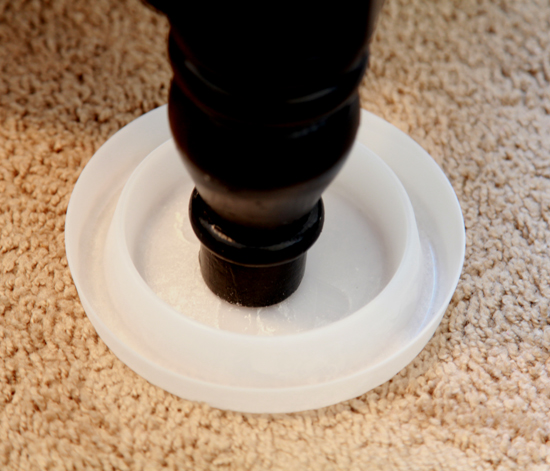
Climbup interceptor cups were effective at detecting bed bug
infestations 95% of the time in the Cooper study. Pitfall traps
like the Climbup detect 3X as many low level infestations
than would otherwise be reported by tenants. |
Another leading bed bug researcher,
Changlu Wang from Rutgers University, offered his own perspective on reasons for the ongoing bed bug crisis in multifamily housing. He said that the biggest challenges come from (1) heavy infestations associated with clutter, (2) widespread resistance to insecticides among bed bugs, (3) the small size and difficulty in finding bed bugs (thus determining whether an infestation is eliminated), and (4) the need for cooperation from residents.
As background, Wang and his laboratory have undertaken some ambitious field trials in the past few years. I say ambitious because it is extraordinarily difficult to do large scale control studies in apartments. Not only do researchers have to work with the same unpredictable clients you work with daily, they also have to get approval from a group called the Institutional Review Board (IRB). Each University has an IRB that oversees any research done with humans or animals, ensuring that the research is done ethically and without harm to its subjects. Getting through the process requires lots of paperwork and is enough to make you crazy.
In a study just published by Wang's recent Ph.D. student,
Rick Cooper, an IPM program was pilot tested at a four building complex with 358 units housing elderly and disabled residents. The IPM program consisted of resident education, initial monitoring with ClimbUp® interceptors to determine which units were infested, encasements, vacuuming, steam, laundering assistance, and insecticide applications with diatomaceous earth and chlorfenapyr. Units with less than 5 bed bugs received non-chemical treatment only. Units that continued to be infested with more than 5 bed bugs after the first treatment received spot treatments with Transport GHP. Followup treatments in all originally infested units were continued every two weeks until no bed bugs were captured in interceptors, seen, or reported by the residents for three consecutive visits.
 |
Relationship between the initial number of bed bugs in a treated
apartment and the number of treatment visits needed to eliminate
the problem. An initial infestation of 100 bed bugs required ca.
10 visits to verify elimination. From Cooper et al. Jan. 2015.
Pest Management Sci. |
Cooper's experiment is the first research to document the success of a bed bug IPM protocol in an entire apartment complex. Key findings of the study were:
- Management was aware of only 29% of the infestations before Climbup interceptors were used.
- It took an average of 2 to 4 minutes (they got faster throughout the study) to install approximately 10 interceptors per apartment.
- It took less than 4 minutes to inspect Climbups compared to over 15 minutes to conduct a visual inspection of an apartment.
- Because of the difficulty in detecting low levels of bed bugs, the authors defined "elimination" as three consecutive visits with no live bed bugs detected by Climbup counts, visual inspections and resident reports. The authors considered the stringent elimination protocol an essential part of the IPM program.
- Researchers estimated the overall infestation rate of the apartment complex was reduced from 15% to 2.8% at 6-months and to 2.2% at 12-months, an 85% improvement.
- In infested apartments the mean number of bed bugs trapped was reduced by 96% and 98% after 6- and 12-months, respectively.
- Heavily infested apartments at the beginning of the study required the most visits to achieve control, hence costing the complex more.
- 62% of residents with bed bugs were not aware that they had bed bugs, including one oblivious resident whose apartment had over 4,000 bed bugs, many of which were openly crawling on the bed during inspection.
- 76% of residents who thought their bed bug problem was solved through treatment still had bed bugs detectable with Climbups, supporting the idea that customer satisfaction should not be the sole criterion for determining when treatments can be stopped.
- Average labor and chemical costs for the 12 month treatment for 66 apartments was $456 per apartment, a figure in line with other programs and which the authors believe can be reduced in subsequent years of a contract.
University of California Survey
In contrast to what ought to be done about bed bugs, Andrew Sutherland of the University of California's Statewide IPM Program, reported on what is being done for bed bugs in the western region of the U.S. He surveyed 114 PMPs in California and other western states and provided some useful insights into current industry bed bug practices. His study confirmed Miller's observation that compared to hotels and single-family homes, multifamily housing was rated by respondents as having the worst infestations, the most-difficult to control infestations, and being the most often treated kind of account. When asked about monitoring methods used for bed bugs, 98% of respondents employed visual inspections "most of the time". Pitfall traps were used at least once by about 75% of respondents; but only 20% said they used this tool "most of the time". About 40% of respondents used canine detection at least once. Surprisingly, glue boards had been used by about 75% of respondents, at about the same frequency as the far superior pitfall traps.
Regarding control methods, insecticides were used "most of the time" by 94% of respondents. Desiccants were used to some extent by 85% of respondents, but only by 57% "most of the time". Encasements were used "most of the time" by 50% of respondents. And 53% of respondents never used volumetric heat treatment--not surprising given the relatively high initial cost of the equipment.
Among liquid sprays, the insecticides used "most often" by respondents were neonicotinoid+pyrethroid combination products (53%), followed by chlorfenapyr (20%), followed by pyrethroids (17%). Among dusts, pyrethrins (surprise to me) were most commonly used, and least used were the highly promising silica aerogels. A copy of the PMP portion of his survey results has been
published in PCT magazine.
In addition to PMPs, Sutherland surveyed 167 housing management professionals, and the results were also revealing. Eighty-seven percent of respondents said that bed bug service in their facilities was complaint-based, just what the Rutger's and Virginia Tech entomologists said doesn't work. Also, 72% of respondents make their tenants responsible for preparing for a bed bug treatment--not a good idea for elderly and disabled who are often unable to perform prep tasks. And 69% of respondents said they used a bed bug addendum as part of their lease agreement. Such addenda generally put responsibility for bed bugs back on the tenant, discouraging many from reporting infestations when they are small and easily treated. These latter results, especially, suggest that the pest control industry, and we in Extension, have some work to do.
These three talks for me illustrated why bed bug management, especially in multifamily housing, remains a challenge. Within the industry better IPM protocols are needed, especially protocols that rely on proactive monitoring and early intervention, sanitation, physical and mechanical controls, and conservative, targeted use of carefully chosen pesticides. I think we also need to take a closer look at desiccant dusts, perhaps an underused, low toxicity tool in the bed bug tool kit. Within the apartment industry, managers and tenants need to be educated about the importance of monitoring-based protocols, minimum prep models, and reversing the "blame the tenant" mindset. All research shows that the sooner a bed bug infestation is detected, the better the prognosis for a quick and less-costly response.
Given that approximately 26 million households reside in multifamily rental housing (2014 data from
National Multifamily Housing Council), there is hardly any pest control issue in the U.S. today that affects more people in a more personal way. The way that pest management and multifamily housing businesses respond to the challenges of bed bugs in the coming years will say a lot about the character of these two industries.