Wednesday, March 16, 2016

Controlling fire ants in gardens

Fire ant carrying bait back to the nest.  Baits do not have to be
applied directly to a garden to control fire ants living inside a
vegetable garden.  USDA image courtesy Bugwood.
One of the common questions about fire ants concerns control within vegetable gardens. This is an especially common question directed to licensed applicators who work for school districts with school gardens.  It also may be an issue for PMPs servicing residential accounts with home gardens.

A standard, low-risk treatment on commercial, residential and school properties is use of a fire ant bait; however many of the most commonly used baits do not allow direct use in vegetable gardens. Fortunately, there is a work-around.

In most cases the simplest way to get fire ants out of a small- to medium-sized garden is to apply a fast acting fire ant bait around the outside garden perimeter.  This should be a legal application for all fire ant baits (check your label to be sure), and since fire ants do not pay much attention to garden edges, the garden infesting ants will readily pick up bait from the surrounding ground.  Yes the bait does end up inside the garden anyway, but only inside the fire ant nests, where there is no risk of it contaminating leafy vegetables.

For larger gardens or cropland where perimeter treatments might be less effective, several fire ant baits are legal for use.  Spinosad and abamectin-containing baits generally allow garden application (e.g., Clinch®, Fertilome® Come and Get It, and Payback®).  In addition, Extinguish® (but not Extinguish® Plus) fire ant bait containing methoprene has a label that allows use on cropland. However Extinguish is too slow for most gardeners, requiring approximately two months for maximum control.

In addition to baits, mounds can be treated directly with any of several mound drenches labeled for use in gardens.  The eXtension website contains recommendations for a two-step (bait and mound treatment) approach to fire ant control in both conventional and organic vegetable gardens.

Appreciation to Dr. Paul Nester (Texas A&M AgriLife) for supplying some of the information used in this post.


Tuesday, March 15, 2016

Do carpet beetles "sting"?

Varied carpet beetle larva.  The tufts of hair on the final tail
segments (right) are barbed and have been associated
with dermatitis and gastrointestinal upset in some people.
Dermestid beetles (Coleoptera: Dermestidae) are among the most common indoor pests throughout the United States.  The principal damage caused by these beetles occurs when they feed on stored products containing animal protein, such as woolen sweaters, rugs, silks, furs and feathers.  Also products containing dried dairy and grain based foods may be attacked. Outdoors, dermestid beetles may feed on dead animals or may scavenge in bird and other animal nests.

What's less known about these beetles is that they occasionally make people sick. I was reminded of this today after being asked whether carpet beetles could bite from two email correspondents.  Now it's true that carpet beetles do not bite, but they can affect people in other ways.

Small hairs called hastisetae are found on the larvae of some dermestid beetles, especially in the genera Anthrenus (carpet beetles) and Trogoderma (warehouse beetles).  These hairs can cause urticaria, dermatitis, vasculitis, lymphadenopathy, and allergic rhinitis in sensitive persons, as illustrated by a recent paper in Pediatric Dermatology from Kara Hoverson and colleagues.

Multiple beetle-caused, excoriated lesions on the
face of a 2-year-old girl. From Hoverson et. al. 2015.
In this paper a two-year old girl experienced skin eruptions on her feet, face and hands.  Subsequently, a few carpet beetles were found in the patient's stuffed animals, mattresses, drawers, baseboards and nightstands, according to the article.  Pesticide applications alone were ineffective in stopping the lesions; but after thorough vacuuming, carpet steam cleaning, and discarding of old bedding and linens, along with physician prescribed ointment treatments, the lesions improved by 70%-80%.  By two weeks after treatment, all lesions were healing. The mother had only a few lesions and the father, who traveled extensively, had none.

An adjoining apartment was found to be even more heavily infested, possibly the original source of the problem.  Occupants of that unit were not bothered by the beetles and refused treatment. Dermestid beetles found in the apartment included larder beetles (Dermestes lardarius), beetles in the genus Anthrenus (carpet beetles) and the genus Attagenus (furniture beetles).

Such hypersensitive reactions are not new to the medical literature.  The Pennsylvania State University published a fact sheet on carpet beetle dermatitis that summarizes reports from 1948 concerning several case histories.  In addition, carpet beetle larvae can cause gastrointestinal upset if swallowed, for example in infested milk, cereal or grain products.

All this does not make carpet beetles an especially alarming indoor pest. Dermestid beetles are very common in homes, especially in the South.  Yet, reports of hypersensitive reactions to contact with carpet beetles are rare in the medical literature. Even when beetles are present in a home, direct contact with humans is not common. And finding a few carpet beetles in a home does not necessarily mean that they are automatically the cause of skin lesions.  Nevertheless, customer reports of "bites" or lesions should be investigated when carpet beetles are apparent.

Complicating matters further, carpet beetles are, not surprisingly, often collected from apartments of people with suspected delusions of parasitosis. This can make diagnosis of such a condition more difficult, because it may require ruling out beetle-related dermatitis as a cause of suspected bites or skin irritation.

Delusions of parasitosis, however, normally involve unreasonably high levels of stress and irrational response to perceived pest problems, beyond what would be considered a normal response to a minor or undetectable pest infestation. PMPs who encounter mystery bug cases where carpet beetles are present, should recommend a thorough (HEPA) vacuuming of furniture and other likely sources of infestation, including cleaning of bed linens.  In addition a thorough inspection should be made for possible sources of a beetle infestation, including use of sticky traps.

I have carpet beetles in my home, but this information will not change the way I view these persistent insects. When I see a carpet beetle my first concern is for any expensive sweaters stored in our closets.  Good housekeeping will keep most carpet beetle populations at acceptably low levels in most homes.  


The annual crane fly invasion

The long-legged crane flies are one of our early
harbingers of spring. Like all flies, crane flies
have only two functional wings--though the
remnants of the second set of wings, borne by most
insects, are visible here as small knobby structures
behind the flying wings.
While concern about mosquitoes floats ominously over the digital airwaves this month, annual flying hosts of crane flies quietly fill the real air over cities and fields throughout Texas.  Crane flies are most apparent each year in our state during the late winter/early spring.  I think of them as one of the first signs that spring is nearly upon us.

The crane fly family is one  of the most diverse families of true flies.  There are over 1500 different kinds found in North America.

The common name "mosquito hawk" is sometimes given to these flies; however the name usually comes with the belief that these insects are predators, perhaps on mosquitoes. Nothing could be further from the truth. Crane flies are among the gentlest of insects.  Some are nectar feeders, sipping sweet sugars from plants and possibly helping out a little with pollination in the process. Other species lack mouth parts entirely.  Instead, the adults of these species live out their short lives relying on fat reserves built up during their underground larval stage.

Crane fly larvae are rarely seen by all but the most dedicated (nerdy?) naturalists.  These long, legless, worm-like creatures may be found in many types of moist soil, sandy areas along streams, rotting vegetation, mosses, or even feeding on organic matter in the nests of birds and mammals.  Very few are considered pests, though the European leatherjacket can be a pest of turfgrass.

Your customers may be seeing crane flies and thinking that the mosquitoes are coming out larger and earlier every year.  But crane flies are generally active before our pest mosquitoes. They can be distinguished from mosquitoes by their generally larger size; but also by their wings, which lack the scales found on mosquito wings. Close examination of the thorax with a hand lens will also show a V-shaped suture just behind the wings.  

So what is good about crane flies?  They are undoubtedly greatly appreciated by hungry birds at this time of year, as well as smaller mammals, fish, spiders and predatory insects.

There is no practical control for crane flies since they emerge from a variety of breeding sites and fly into backyards regardless of pest control measures.  Instead, perhaps we should encourage our customers to "enjoy" crane flies while they last.

Some of your customers may think more kindly of these gentle and harmless insects when they learn that they only have love on their tiny minds.  The sole activity and goal of the adult crane fly is to find a mate and, for the females, to lay eggs for next spring's crop of flies. And who wants to get in the way of love?

Friday, March 11, 2016

Zika Updates

Things have happened so quickly on the Zika virus front over the past three months, I thought a short update might be in order.  You may recall a post I wrote in December warning about a need to brace ourselves for what might possibly be a big year for the new Zika phenomenon.  As my wife might say, "Well, at least you were right this once."  A quick peak at Google Trends surely bears this out.  The following graph shows the relative number of times people on the Internet used the search term "Zika" in recent years:


Much of the excitement about Zika virus, of course, has centered around the possibility, insisted on by many Brazilian public health officials, that there is a connection between Zika infection and a condition in newbornes called microcephaly.  Since the initial reports, there has been some pretty wild speculation about whether Zika really is the cause of the condition.  One was a blog posted on Reddit, a "social networking newsite" that bills itself as "the front page of the Internet".  The post speculated that the real reason there had been no previous connection between microcephaly and Zika was that the microcephaly in Brazil was actually linked to experiments with genetically modified mosquitoes in some parts of the country where microcephaly was rampant. Many people have since discredited the logic behind this conspiracy theory.  But expect this idea to float around the Internet for a long time anyway--that's what conspiracy theories do.

Another theory posted online claimed that the real reason for microcephaly increases in Brazil is a pest control insecticide being used in the drinking water of Zika outbreak zones.  The insecticide was pyriproxifen, which we in the pest control industry use under the trade names Nylar® and Archer® flea and roach sprays. The anti-GMO group blaming pyriproxyfen claims that the association between microcephaly and areas where pyriproxyfen is used "is not a coincidence." Like the genetically modified mosquito claim, this group also asserted that so far, there have been no cases of microcephaly reported in other countries affected by Zika. While microcephaly does not (yet) seem to be as prevalent in some Zika areas, like Colombia, this claim is not strictly true. Higher rates of central nervous system malformations were also found in French Polynesia following the Zika outbreak there in 2014.  In addition, there is no scientific evidence of any connection between pyriproxyfen and brain abnormalities, and officials in Brazil point out that some areas that do not use pyriproxyfen to treat mosquitoes still have seen increases in microcephaly.  Pyriproxyfen, by the way, is an insect growth regulator that is one of the lowest toxicity treatments (LD50 greater than 5000 mg/Kg) available for fleas, cockroaches and other pests. The EPA does not consider it an endocrine disruptor, and it is not considered a carcinogen.

On the scientific side, last week an article was posted in the New England Journal of Medicine (a much more reliable source than social networking news sites) that provides some of the strongest evidence yet for a link between Zika and microcephaly.  Fetuses from 42 women with evidence of Zika infection during gestation were examined.  Preliminary analysis of ultrasound examination of these fetuses showed 29% (!) occurrence of microcephaly in infected women compared to 0% in 17 non Zika infected women.  The authors concluded that "despite mild clinical symptoms, ZIKV infection during pregnancy appears to be associated with grave outcomes, including fetal death, placental insufficiency, fetal growth restriction, and [central nervous system] CNS injury."

If research continues to show similar associations between Zika infection and microcephaly the stakes are surely raised this summer with thousands of expected travelers coming back into the U.S. from Zika zones, including the Olympic venues in Brazil.  All the more reason for all of us to be aware of travel safety recommendations by the CDC.

For our part, Texas A&M is also ramping up its educational efforts this summer with launch of a new website to collect information pertaining to ways to prevent Zika.  The bottom line of all the current news, however, is that there is currently no way to prevent getting the disease from an infected mosquito other than by avoiding mosquito bites.  And pest control is an important part of that equation.  So take the time to learn more about the Aedes mosquitoes that carry Zika, and consider how you might respond to the concerns that are sure to be around this summer.

Monday, February 8, 2016

Spring mosquito seminars

Today the Centers for Disease Control and Prevention took the remarkable step of elevating its Zika response to the highest emergency (Level 1) priority outbreak.  For a virus not even established in the U.S., this illustrates the respect and fear health officials have for this previously unheard of virus.

So what's the story behind the Zika virus?  How do you recognize the mosquitoes that might transmit it? What's the difference between managing mosquitoes that carry West Nile virus and those that carry Zika? If you don't know all the answers to these questions, it might be time for an update.

For the third year in a row Texas A&M AgriLife Extension will offer regional vector management workshops with a focus on mosquito control.  These workshops are designed to provide municipal and county health department staff, pest management professionals, and anyone with an interest in mosquito control, with a good basic introduction to urban mosquito identification, biology, ecology and diseases--including Zika. In addition, Dr. Sonja Swiger and other experts will provide information about mosquito trapping, surveillance programs and control.

The workshop has been confirmed for sites this year:
  • San Antonio - March 8
  • Abilene - March 11
  • Round Rock - March 21
  • Grapevine - April 5
  • Rosenberg - April 13
The workshops will run from 8:30 am to 3:00 pm and will offer 5 Agriculture CEUs (2-general, 2 IPM, 1 Laws and Reg) and 3 Structural CEUs (1 Pest, 1 IPM, and 1 Laws/Regs) for pesticide applicators.  There will also be CE units offered for Registered Sanitarians and Animal Control personnel.  Cost of the workshop is $50 per person, which includes a meal.  Preregistration is required.  To register for all but the Grapevine location, click here.

The Grapevine location this year will be co-hosted between AgriLife Extension and Municipal Mosquito.com/EnTex Pest Solutions. The April 5 date will include slightly different times and costs, as well as an expanded agenda. Mosquito and epidemiology experts from the CDC, State of Texas, and North Texas area present the latest information about established and emerging arboviruses, and evolving response scenarios. For more information, go to the 2016 North Texas Mosquito Education Workshop.

This year's workshop, like in previous years, will focus on all mosquito health threats, not just Zika. With mosquito season almost upon us, make sure you and your employees can respond to the many concerns about this year's mosquito season. Don't miss out on this chance to get the latest updates, and be get ready to face an energized public with more questions than ever.

Friday, January 22, 2016

Bat mites and bat ticks...really?

Bat mite bites to humans are rare, most commonly occurring
when biologists handle infested bats or work in caves among
mite-infested colonies. Photo: Elaine Miller Bond
For me it's not uncommon to get questions about biting mites in homes. While some cases can be traced to actual infestations of rodent or bird mites, most do not. In cases where I cannot detect a valid pest, and the pest physical description or behavior doesn't reasonably match any known pest, I consider the case to likely be a non-pest problem.

However a recent email begged for help with some sort of biting bug in their home.  The bug could not be seen, the writer said, but two pest management companies suggested the problem could be either bird mites or "bat mites". According to the email, both companies treated the home with insecticide but (surprise!) the treatments did not solve the problem.

It being winter, and the client not mentioning anything about birds nesting in the home, bird mites did not seem likely. But the claim about bat mites caught me off guard.  Over the past few years I've had many callers ask about bird mites, but never bat mites. I wondered if there even was such a thing?  I could conceive of bats possibly overwintering in a chimney or attic of a home, so perhaps a winter infestation of mites is possible?  In searching my medical entomology and structural pest control books, the only reference to bat mites was Mallis' Handbook of Pest Control.

Mallis cites a single report of bat mite dermatitis published in a 1973 Journal of Medical Entomology. The report described an old rural home in northern California infested with bats. A baby in the home suffered from a chronic dermatitis on the face and abdomen.  Investigators found the child was being bathed on a sink where mites were visibly evident, next to a wall infested with Mexican free-tailed bats. Adults and an older child in the house were not bitten. Once the child's bathing site was changed, and bats eliminated from the home, the biting problem stopped. The mite species was Chiroptonyssus robustipes, whose sole host appears to be the Mexican free-tailed bat.  This was clearly an unusual situation, and one never since reported in the medical or pest control literature that I can discover. My medical entomology textbook notes that bat mites rarely bite humans, and when they do it is usually zoologists handling infested bats or otherwise working in caves among mite-infested bat colonies.

Bat ticks are not uncommon in homes where bats are active or
have recently left the structure after breeding. (Courtesy Iowa
State University)
Complicating things a bit, a colleague pointed out to me that ticks are also associated with bats. Ticks are related to mites, but larger and always parasitic. The bat tick, Carios kelleyi, is a soft tick (1/8-3/8 inch-long) and, according to an Iowa State University publication, is routinely found in bat-infested homes in that state. It is found throughout the U.S.

Ticks in the U.S. are classified as either hard ticks (family Ixodidae) or soft ticks (family Argasidae).  By far the most common human biting ticks are hard ticks, like the deer tick and brown dog tick. Soft ticks are less commonly encountered by humans and are mostly parasites of birds and bats.  They have a leathery, folded cuticle that resembles a crushed felt hat when seen from above. Carios kelleyi is of some medical concern as it has been reported to bite humans and is known to carry at least three types of pathogens, including Borrelia species, the causative agents of tick-borne relapsing fever.

I've never had a bat tick sent to me for identification, nor heard of a human bitten by a bat tick. My colleague Richard Pollack with Identify.us.com commented that each bat tick he has received was misidentified by a professional who "should have known better". Several were PMPs, but one was a veterinarian (who thought the tick was a tapeworm segment), and a doctor who thought "it was some kind of alien being".  I hope readers of this blog will be better equipped when one of these strange critters shows up.

According to a review by Loftis et. al (2005), documented cases of bat ticks biting humans are rare with only one verified U.S. case, in Iowa--and probably the reason that the only state with an extension publication on these ticks. The solution for a bat tick infestation is removal and exclusion of the bats, along with application of residual dusts and/or sprays in suspected roosts and points of entry into the home.

Which brings me back to my email query from the worried Texas homeowner.  Given the rarity of bat mite or tick infestations throughout the country, and even greater rarity of human bites from these arachnids, its doubtful that this case was correctly identified by the PMPs involved. Because no mite or tick could be produced, it's more likely that this was not a true pest problem, and no pesticides should have been applied.  However, when called out on cases like this, it's especially important for the PMP to eliminate all possibilities, including nest parasites (mites and ticks) of birds, rodents and other mammals, including bats.

When faced with mystery bugs in a home or office situation, keep the following in mind:

  • Sticky traps can capture mites and ticks and should be used in all areas of the house where the customer believes that suspected "bites" are occurring.
  • Take the possibility of mites seriously by inspecting the structure for signs of wildlife or rodent entry. Recommend closing, or using one way doors, any suspected entry points.
  • If no evidence of wildlife is present, and no specimens of mites, ticks, fleas, bed bugs or other biting pests can be found, it's generally best to not apply pesticides.  Explain that your company follows IPM principles and that you try to avoid unnecessary applications of insecticides for the sake of your customers and the environment.

A professional knows how to deal with both the common scenarios, and understands something about the uncommon possibilities, like bat mites and bat ticks.


Tuesday, December 29, 2015

Bracing for Zika

Will Zika be the next mosquito-borne disease to capture headlines in 2016?  Or will it be the little disease that few (at least in the U.S.) have heard of?  That's the question being debated by public health officials this year.

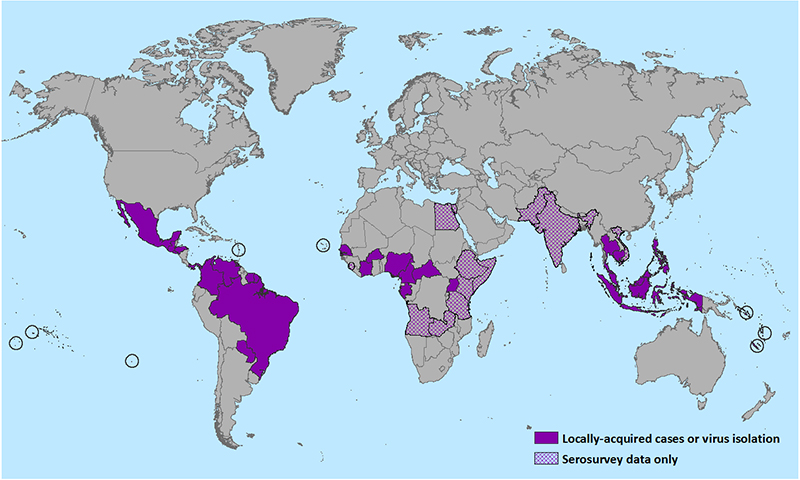
Current (2015) worldwide range of zika virus. Central and South
American countries were first reported with the disease in
2015 (U.S. Centers for Disease Control).
For many years it seemed like new things happened relatively slowly in public health in Texas. In the mid-1980s entomologists reported the Asian tiger mosquito in Texas for the first time--a daytime-flying mosquito from Japan that is not shy about biting humans. Then in 2002 the first cases of west Nile virus hit our state.  Carried by the southern house mosquito, WNV affected a couple of hundred people or less each year. This was the case until the blazing hot summer of 2012 when over 1800 cases were reported, including 83 deaths. Health departments throughout the state are still reeling, in some ways, from the impact.

Now health officials are bracing for another mosquito-borne disease caused by Zika virus (abbreviated ZIKV by epidemiologists).  A cousin of west Nile virus and dengue fever, ZIKV has been thought of as a less severe form of these flavivirus.  Most people who get ZIKV show no, or very mild symptoms.  Others exhibit a rash, conjunctivitis (inflammation of the eye), and flu-like symptoms.  Most people do not get as sick with ZIKV as with dengue fever or chikungunya, and recover relatively quickly.

For this reason, since its discovery in 1947 until 2007, it was not on the radar of many public health experts. But in 2007 ZIKV cases started to spread throughout Micronesia French Polynesia, and eventually Easter Island. There it was thought to possibly be the cause of a twenty-fold increase in cases of Guillain-Barre syndrome--an autoimmune disease of the central nervous system that can be highly disabling, at least temporarily.

In 2015 the disease made its appearance in Brazil and has since spread to at least nine other member states of the Pan-American Health Organization (PAHO/WHO), and prompting that organization this month to issue an alert to all of member public health agencies.

So here's where things get a little scary.  Since the arrival of ZIKV to Brazil, the virus has been detected in babies born with a condition known as microcephaly.  Microcephaly is a relatively rare condition where the brain fails to develop normally. It may result in miscarriage or in babies being born with under-sized brains.  There is no cure for the condition.  The PAHO/WHO alert noted that the number of diagnosed cases of microcephaly has increased to 2700, a 10-fold increase, in Brazil this year.  Health officials there are worried that there might be a connection between this unprecedented increase in microcephaly and the arrival of ZIKV.  And last month, unusual nervous system birth defects were also reported in Polynesian mothers who tested positive for flavivirus antibodies.

Public health officials guess that these cases may result when a pregnant woman who is bitten by an infected mosquito contracts the virus.  The virus then infects the developing fetus, resulting in this serious condition.

So far there is no hard proof of a connection between ZIKV and microcephaly or Guillain-Barre syndrome, but medical researchers are rushing to learn more about the virus and its possible effects on human health.  According to one expert, quoted in the New York Times, it could be that the risk of microcephaly is increased among people who have previously contracted dengue fever or chikungunya, neither of which diseases are common to Texas or the U.S. If this hypothesis proves correct, the risks to the unborn in this country would likely be negligible.

Currently, ZIKV is thought to be transmitted by the yellow fever mosquito, Aedes aegypti.  This mosquito, along with its close relative, Aedes albopictus, the Asian tiger mosquito, are both very common throughout Texas and the southern U.S.  Unlike west Nile virus, which is primarily a disease of birds, ZIKV is solely a disease of primates.  To be spread among people, it must be picked up from another infected human.

Dengue and chikungunya are similar, human-only, viruses that have not been quick to spread in Texas or other U.S. locations.  This may be the result of lower rates of mosquito biting in the U.S., perhaps due to our more indoor lifestyles, or more common use of repellents.  Some experts argue that for similar reasons ZIKV is likely to be slow to establish in the U.S.  Nevertheless, Brazil shows that given the right conditions, this virus is capable of establishing itself very rapidly, with 85,000 known infections in its first year of spread.

A few U.S. cases of ZIKV have been reported in 2015, but all from travelers who contracted the virus elsewhere.  Mexico has also seen a few cases this year.  There are still no known cases of ZIKV, however, contracted within the U.S.

So be prepared to hear more about the zika virus this year.  It may turn out to be a big event, or it may not.  Even if we didn't need more reasons to dislike biting mosquitoes, now we have one more reminder of the importance of residential mosquito control, and putting on the insect repellent when venturing outdoors.