Wednesday, August 1, 2012

Pyrethroid labeling confusion

New FMC videos explain pyrethroid label changes.
In April I posted information on the new pyrethroid label changes being required by the U.S. Environmental Protection Agency.  While the information in my April 17th post was correct, I later (May 1) posted a comment based on additional information I received from the EPA.  In that follow-up comment I said that, according to EPA, that ALL outdoor pyrethroid applications (not just preconstruction treatments as stated in the article) would not be permitted when windspeed was over 10 mph.  The problem is that I was misinformed by my EPA source.

I shared EPA's May 1 label interpretation with Dr. Jim Fredricks at the National Pest Management Association.  He and his legislative colleague, Bob Rosenberg, followed up with EPA on this information.  In an email dated 19 June 2012, Rosenberg received a response from EPA stating that their original "response (the one I received) was not correct... the 10 mph wind restriction applies only to products labeled for preconstruction termiticide applications." [my emphasis]

To those of you who read my comment, I apologize for passing on the wrong information.  Thanks to NPMA for following up and ensuring that all of us get the correct information about pyrethroid label changes and what they mean. BTW, this is a great example of the kind of service tha the NPMA provides its membership as it looks out for the interest of the industry.

I have since removed the incorrect information from the April post's comments; however pyrethroid labels may include advisory language recommending application should be made during "calm weather when rain is not predicted for 24 hours".  This may be more difficult to gauge and document than the 10 mph requirement.

As usual, if in doubt, read the label.  If it's a pyrethroid label, be extra careful over the next few months to check every pesticide container.  During this transition period some containers will have labels that have the new language, and others will not.  While technicians are OK if they use a product with the old language, it would be a good idea to train and require all your employees to start following the tighter restrictions now.

FMC Professional Products has produced some nice new videos explaining the new pyrethroid labels. Check them out at the FMC YouTube Channel.

Tuesday, July 3, 2012

A personal experience with bed bugs

One of the first bed bugs we discovered was this well-fed adult
on the mattress seam.
Last month, one of my daughters called me on the phone, panicked. "Dad, I think I've got bed bugs!"

It turned out to be more than a couple of bed bugs.  She had a full blown infestation.

Over the years my children have mostly just tolerated, if not ignored, my entomological passions. But this daughter is no slouch. She knew a few things about bed bugs. Like many people it just never occurred to her that bed bugs could happen to her.

The bites she'd started to notice in the morning? Probably mosquitoes.  The little red spots on the bedding? Probably from the mosquito bites. It wasn't till she saw two bed bugs frolicking on the sheets at night that it finally clicked..."Of course! How dense can I be? My dad taught me better than that!" (I added that last part)

Small blood spots on sheets are easily dismissed by someone
not familiar with bed bugs. Blood spots are a more sure
diagnostic sign of bed bugs than just "bites".
A visit to her apartment the next day revealed 200 to 300 bed bugs happily tucked away in the corners of the fitted sheets, dust ruffle and box spring cover of her bed.  We did some thinking back and concluded that we had probably introduced the bed bugs last February when she retrieved her mattress and box spring from a friend living in a (nice) uptown Dallas apartment.  She had loaned the bed to friend during a transition period when she was living at home after graduation.  I say "we" introduced the bed bugs because I helped her move the bed from friend's apartment to her new home in Fort Worth.  I didn't notice anything out of the ordinary at the time, but I wasn't really thinking bed bugs either.

Of course my daughter's first concern was where to sleep. As with all of us, ignorance is bliss. The night before her discovery it was OK to sleep in her infested bed. But now that she knew her bed was crawling with unwanted vampire bugs, it just wasn't the place for a restful sleep. I can't say I blamed her.

It's times like these that both she and I appreciated the availability of a pest control professional at the other end of the phone. In her case, the landlord was supportive and had a pest control company ready to come out and treat her apartment.  The problem was, what to do in the meantime.

In general it's not a good idea to abandon one's bed as a solution to bed bugs. The problem is that once you start sleeping on the couch, it's just a matter of time before the bed bugs figure out where supper has moved and you end up with bed bugs in another room of the home. But for at least one night I counseled her to sleep on the couch and I would be over the next day to help.

A dis-infested bed ready for clean sheets is now a
relative oasis from bed bugs until the PMP arrives. 
Because I wanted her to get back in her own bed as quickly as possible, we opted to make her bed safe while waiting for the professionals to arrive. With the generous help of friends at Target Specialty Products, I was quickly supplied with Mattress Safe® bed encasements, a set of Climbup® Bed Bug Interceptors, and a can of Zenprox® aerosol insecticide.  Vacuum at hand, we removed as many bed bugs as possible from the mattress, sheets and dust ruffle, box spring, and bed (At this point, long-suffering daughter had to put up with a dad who, every couple of minutes, had to stop and take closeup pictures to document the infestation--a small price to pay, I kept reminding her).  After slipping the mattress and box spring into their encasements, we continued vacuuming and tearing down the bed.  Once disassembled, I treated bed cracks and crevices with Zenprox, reassembled the bed and put Climbup® traps under the bed posts.  To keep anything from touching the floor, except the bed posts, we eliminated the dust ruffle.  All sheets and bedding were immediately stuffed into garbage bags and sealed tightly for transport to the laundry.

To make a long story short, daughter returned to sleep in her own bed that night, and after a month reports no more bed bugs. Of course the PMP arrived the next day and undoubtedly deserves much of the credit for  successfully keeping the infestation from spreading; but the experience taught me several things that I will take with me as I advise clients with similar problems.  I hope these thoughts will also help you too as you deal with frantic customers:

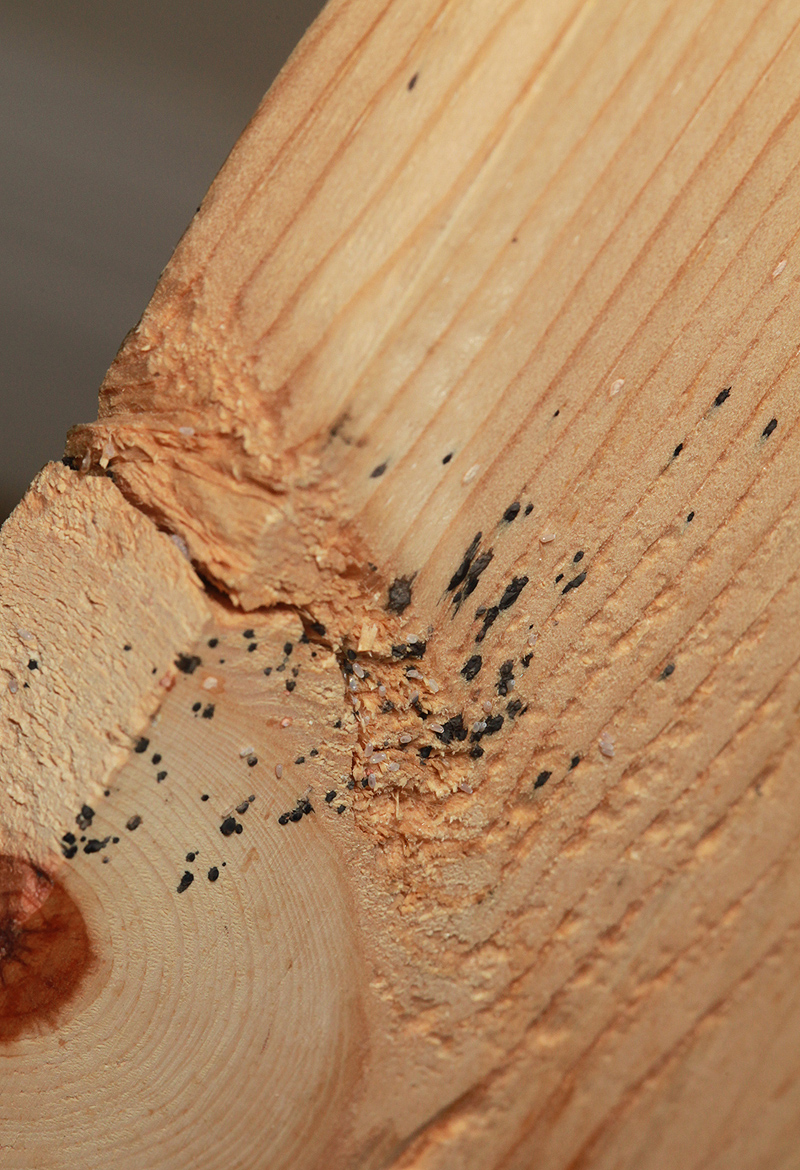
Bed bugs prefer laying eggs on rough
surfaces, like this bed slat. I initially
photographed this wood because of the
fecal droppings, but later counted at least
28 eggs in this image alone. Double-click
the image and see how many you can find.

  • Don't think that just because a customer has an advanced case of bed bugs that they willfully allowed the situation to progress.  Many people experience mild to zero reactions to bed bug bites, and have no idea that they are feeding dozens to hundreds of bed bugs. A recent, informal study of Orkin employee reactions to bed bug bites reported by Ron Harrison at the NCUE found that less than one in 20 people showed any noticeable reaction to bed bug bites. 
  • Because many people think bed bugs will never happen to them, they tend to overlook bed bug clues that, in retrospect, are obvious.
  • Customers need guidance in how to survive the waiting period between bed bug discovery and when service can be provided. I know that many of you respond to bed bug calls with next day service, but inevitably there will be customers who will have to wait two or more days.  Providing landlords with a variety of sizes of mattress encasements, Climbup® or similar traps for bed posts, and vacuuming instructions ahead of time can help renters survive the agonizing wait for service. By creating an oasis of safety in the midst of an infested apartment, you allow the customer a chance to sleep comfortably in their own bed without running the risk of spreading bed bugs to other parts of the apartment or home.
  • Remind your regular customers about the signs of bed bugs.  The earlier an infestation is caught, the better the chances of bringing it under control quickly.
  • Use bed post interceptors wherever feasible.  Even after treatment these devices provide you and the customer with a sensitive way to monitor the effectiveness of control. In my daughter's case, not all bed bugs were killed with the initial treatment, as evidenced by several more bed bugs being caught in the Climbup® cups in the succeeding weeks.
  • Plywood beds or rough wooden bed slats are especially favored places for bed bugs to lay eggs.  Study of closeup photographs of the wooden slats on my daughter's bed after I treated showed me  dozens of eggs I didn't see on inspection. Even though these slats were treated by me and by the PMP with insecticide and steam, we opted to remove the slats (they weren't necessary for supporting the box spring anyway) afterwards. 
  • While I recommend bed bug-proof encasements as a less expensive (and more effective) alternative to throwing away infested mattresses and boxsprings, throwing away plywood bed stands or other types of rough wooden beds might be a good idea for some customers. Replacing such beds with a metal, or smoothly finished wooden four post bed, or an inexpensive metal bed frame on wheels, will allow you to create a safe, bed bug oasis even in the midst of a bed room that still harbors live bed bugs.
  • Our industry needs better, more detailed explanations for customers on how to treat bagged clothing and personal items. My daughter didn't receive very helpful information about what to do with all her "junk" once it had been bagged in preparation for service.  Even the PMP had few, helpful suggestions on what to do with personal items other than "wash everything".  But more on that in a later blog.
My final, take-home lesson in all this is to not loan your bed and mattress to anyone.  Even if your dad's an entomologist.

Thursday, June 7, 2012

Tarantulas go a-courting

My captive, 7+ year-old Texas brown tarantula was given me
 by PMP, Tim Sloane, who collected it from an urban backyard.
This has been tarantula week in Dallas. I don't get too many tarantula calls as a rule; tarantulas are nocturnal homebodies, rarely venturing more than a foot from their burrow...except during mating season. For a short time in the spring (and to some extent in the fall), usually after a rain, male Texas brown tarantulas (Aphonopelma hentzi complex) leave their burrows and hidey-holes in search of--what else?--romance. In some parts of the state dozens of spiders may be seen at once, especially at night along lonely west Texas highways.

According to Burr Williams of the Sibley Nature Center in Midland, who has observed tarantula courtship in west Texas, once a male catches a female's pheromone scent, they seem very good at orienting to a female's burrow. The male taps at the entrance and the female lunges out. The male grabs her, mates quickly, and it's over--sometimes permanently for the male.

Most authorities (e.g., Thomas Prentiss in Ubick et. al, Spiders of North America) say that mature male tarantulas don't live long. Whether this is because they usually get eaten, or just don't have what it takes to be a long-liver (females have been observed to live 30 years in captivity), I'm not sure.  But the male spider I placed yesterday in a terrarium with my 7-year-old female Texas brown Tarantula certainly didn't last long. This morning a leg and a few unidentifiable scraps of carapace were all that was left. I can only hope he enjoyed his final moments.

According to a 1999 study by Margaret Janowski-Bell and Norman Horner--who put little radio antennae on the backs of tarantulas and followed them around the desert (how cool is that!)--males in the wild may visit multiple females, and thus must have a better chance of escape from the than my unlucky captive.

Most of the folks who called about tarantulas this week seemed worried.  One gentleman was worried that his child would be bitten. Another was ready to sell his house and move (presumably as far away from Texas as possible) after finding his backyard and and exterior walls of his home hosting multiple tarantulas. 

Fortunately, tarantulas are not that dangerous. Forget Spielberg's Arachnophobia if you can, a tarantula is a shy giant of a spider. The venom is not considered especially toxic, on the order of a bee sting. But the chance of being bitten by a tarantula is slim. Add to that the fact that tarantulas, like all spiders, do much good by controlling the general insect population.

A tarantula mysteriously ended up on
Dr. Knutson's shirt while gardening in his backyard. 
Having said this, I am likely to undo all my "spider good will" by sharing a recent adventure of my friend and colleague, Dr. Allen Knutson. Allen lives in an older neighborhood of McKinney, Texas.  He and his wife notice tarantulas from time to time on walks in their neighborhood. Nevertheless it was a shock for wife when Allen walked into the kitchen after working in the garden recently with a hitchhiking tarantula. Thinking she was making a lot of fuss over a little spider, even entomologist Allen was surprized to find a 4-inch male tarantula clinging to his back.  After being quickly shooshed out of the house, Allen was brave enough to stand for the accompanying picture. He noted matter-of-factly that the spider looked much bigger in real life than it does in the picture. I'm sure.

Try as I might I can't force myself to encourage the pest control industry to kill tarantulas.  Yes, I know it's what some of your customers want. But to me tarantulas are just way too cool, and deserve their little hole in the ground where they (almost) never bother anyone.  So this is what I'm going to do--we'll compromise. According to my arachnologist colleagues, science has a need for tarantula specimens. If you collect a tarantula, I will accept it (live or dead) and send it to the spider community via the Texas A&M University insect collection. If you kill it first, put it in a jar of alcohol to preserve it, otherwise bring it live to my office, following the instructions on this page. I'll make sure the little guys and gals don't die in vain.

Tarantulas are a sign that things are as they should be. They represent a healthy ecosystem where pests must fight for their miserable lives. And they're a sign of Texas. After all, what would Texas be without its prickly pears, tarantulas, scorpions, rattlesnakes and brown recluses? I know one thing for sure. It wouldn't be Texas.

Tuesday, May 29, 2012

Urban entomologists in Georgia

Atlanta is home to historical memories of the Civil War and William T. Sherman's infamous march to the sea. It's also known for its peaches, the Atlanta Braves, Coca Cola world headquarters, and the Jimmy Carter Presidential Library.  It is lesser known as the home of Rollins Inc. and the Orkin University and Training Center, a state-of-the art training facility for Orkin sales and pest control staff. It is also lesser known for being the probable entry point into the U.S. for a new invasive insect known as the kudzu bug.

Orkin Trainer Jose Dolagaray explains the design and use of the
termite training facilities to conference attendees visiting the
Orkin University and Training Center at Rollins headquarters.
The last two points were of great interest last week, at least to the 220 or so entomologists attending the 2012 National Conference on Urban Entomology.  This is the largest conference in the U.S. (and likely the world) focused solely on the science of urban entomology, and is a great place to hear the latest news and research on bed bugs, cockroaches, termites, and many other urban insect pests.  Of the 43 talks I attended over three days, some of my personal highlights included the following reports [my apologies ahead of time to termite people--most of the talks I attended were bed bug-related]:

  • Dini Miller of Virginia Tech provided a very practical case study of failure to control cockroaches in what she said was the worst multifamily housing cockroach infestation she had ever encountered (and for Dini, that's saying a lot). Student researchers averaged 200 cockroaches per unit per night in 36 "high-clutter and poor sanitation" apartments in a city housing authority. Miller showed that baits can be effective in such poorly maintained apartments when the infestation was reduced significantly with a simple service involving application of 30 grams of gel bait per unit followed by a 14-day followup treatment.  When the units were turned back to the pest control company for maintenance, the populations increased to above the previous infestations within 4 weeks.  The reason? One technician was not sufficient to service the number of cockroach infested units in the complex, and not enough bait was being used in each unit to halt cockroach population growth. Miller showed that 45 minutes was required to put out an average of 916 grams of bait per unit during an initial visit.  With a good first treatment it only took 6 minutes per unit, and an average of 494 grams of bait, on a 14-day followup visit.
        The take home lesson from Miller's research is that pest control companies can't just go through the motions of baiting to get control of out-of-control cockroach infestations. Adequate time to survey, locate and treat cockroach harborages, as well as enough bait to manage the population is essential to a good treatment.  Miller's baiting formula (she used Advion and MaxForce Magnum gel baits) required 60 grams of gel bait per apartment when overnight trapping yielded more than 500 cockroaches, 30 grams for 100-500 cockroaches, and at least 15 grams for 50-100 cockroaches. AgriSense Lowline traps were used for all monitoring in the study.
  • The BASF folks generated food for thought with several studies of their products including two Phantom formulations, Alpine dust, and their pyrethrins aerosol, HydroPy. Jason Meyers reported that 4-month aged residues of Phantom SC, and 180 day aged deposits of Alpine dust, performed as well at controlling bed bugs as fresh deposits of the insecticides. Such long residual deposits are unusual in pest control, making it necessary for frequent re-treatments to prevent pest reestablishment.
         With this data in hand, Meyers made a case for what BASF will be calling proactive bed bug control.  Because of Phantom's long residual, the company is conducting field tests to see whether two proactive (=preventive) treatments a year can keep bed bugs from establishing in hotel rooms.  Treatments of Phantom aerosol are applied twice a year to bed frames/head board and luggage rack.  Alpine dust is used once a year and applied to hotel room box springs, electrical outlets, carpet edges, baseboards, picture frames, electronics and sofas/chairs.  So far no new infestations have occurred in a Kansas hotel being used as a proof-of-concept site.  Expect to hear a lot of discussion about whether this approach can be justified as IPM, and whether it works sufficiently well to write preventative contracts for bed bugs in hotels. According to Orkin entomologist Ron Harrison, Orkin is one large company that expects to do more proactive bed bug control with its hotel customers in the future.
  • Standardized assay methods for testing insecticides for bed bug control are a hot topic right now with regulators. One of the points of contention is which bed bug strain(s) to use. Bed bugs vary wildly in their susceptibility to insecticides.  Currently it is possible to pick a strain, like the almost completely susceptible Harlan strain, that will make nearly every insecticide look like a winner. But, according to Mike Potter of the University of Kentucky, 88% of bed bug populations tested from 110 sites around the U.S., had at least one type of resistance to insecticides.  Hence testing products against only the susceptible strains is nearly meaningless as a predictor of real-world effectiveness. But which strain or strains to use? It turns out that even the search for the perfect test strain is a moving target. According to Sumiko De La Vega, of Sierra Research Labs, even insecticide resistant strains lose their toughness after a few years in laboratory colonies.  One of Sierra's standard colony types lost most of its 2000-fold permethrin resistance over a 2-4 year period of no exposure to pyrethroid insecticides.  Frequent resistance testing may eventually become necessary for the performance of insecticide testing with bed bugs, making such tests more difficult and expensive.
  • Some of you may have wondered what happens to insecticide residues that are exposed to the high temperatures of heat treatments for bed bugs.  Apparently heat is not that destructive to residues of many of the commonly used bed bug materials. Temprid, Transport, Phantom SC, Phantom aerosol and a Phantom+IGR experimental formulation showed no loss in efficacy after 7 hours at 135 degrees F, according to PhD student Margie Lenhert from Clemson University.
  • More of us may be providing dinner for bed bugs than we realize, according to an Orkin in-house study conducted by Ron Harrison.  Harrison noted that early research conducted 50+ years ago suggested that perhaps over 80% of people showed some kind of reaction to bed bug bites. However, his informal study, using over 1400 Orkin company volunteers, showed that only 3.8% reacted quickly to bed bug bites. Only 1.1% showed any delayed (4 days or more) reaction.  If these numbers are accurate, the number of biting cases in hotels may be substantially under-reported.  In addition, lack of skin reaction in many people could explain why many customers who report infestations wait until bed bugs reach high numbers in a home or an apartment.
  •  
    NPMA graphic illustrating words that people use when
    asked what comes to mind when they hear the name
    "bed bug". The larger and bolder the word, the more
    common the response (graphic courtesy Jim Fredericks).
    Jim Fredericks of the National Pest Management Association reported on new online bed bug resources.  Allthingsbedbugs.org is a new consumer oriented site published by NPMA.  Its best management practices tab, however, would be a good place to compare your company's practices to see how they hold up to industry standards.
  • Rick Cooper, graduate student at Rutgers University, attempted to conduct field evaluations of bed bug sniffing dogs.  He noted that previous canine detection research reported in 2008 showed that dogs were capable of relatively high (95-98%) detection rates (correctly pointing out all bed bugs) and relatively low false positive rates (approximately 3% of the time dogs pointed to bed bugs that weren't there).  Cooper pointed out that the 2008 study was conducted under controlled conditions with planted bed bugs.  His study was conducted in real apartments, where bed bug infestation sites were well-known from previous, thorough checks by trained inspectors.  In one of his trials, he worked with 11 companies that claimed 95-98% detection rates (generalizing based on the published 2008 results).  In Cooper's study, actual detection rates in 48 apartment units averaged only 50% (ranging from 10-83%) for these companies, and the average number of false positives was about 20% (ranging from 0-43%). Even narrrowing the trial to his best, most experienced, teams, he was unable to replicate the high success rates of the controlled studies. Despite his respect for canine detection, he concluded that canine accuracy rates in the field are likely much less than what most canine handlers advertise, and that false alerts are higher in rooms with past history of bed bugs.  
         False positives are undoubtedly costing the public lots of money.  In a widely publicized bed bug infestation at the University of Nebraska, dogs used to inspect campus dorm rooms alerted in 197 of the 3256 rooms.  Evidence of bed bug infestations, however, were found in only 10 of the 197 rooms. Because of the publicity, and high public profile of the effort, all 197 rooms were treated, at a cost to the University of $400,000.  According to Cooper, the philosophy about canine detection is changing. In the past it was "trust the dog"; today, it's "check the alert" (with a visual inspection).
Strategically placed Plexiglas cutouts show trainees at the
Orkin house, normally out-of-site construction features
important to pest control, such as this bathtub plumbing. 
In addition to hours of Powerpoint slide shows, participants in the NCUE conference were treated to a field trip to the Orkin University and Training Center. The facility is very impressive with mock kitchens and grocery stores, numerous outdoor termite treatment training stations, and the Orkin House, a full sized home with numerous examples of pests, pest damage and structural cut-aways to show how homes are constructed and how insecticide treatments might interact with a building.  One of the highlights of the tour, for at least a few of us entomologists, was searching for the infamous kudzu bug on the kudzu vines so common in the Atlanta area.

Friday, May 18, 2012

Ant webinars posted

Learn A couple of weeks ago I announced two upcoming ant Webinars, and made some comments about how Webinars were "the next big thing" in continuing education. I hinted that if you haven't tried participating in a Webinar yet, you need to. If nothing else you can impress your teenage kids at the dinner table with your growing computer skills. OK, maybe not. But there is another advantage of the webinar that I didn't mention. If the presenting agency is on top of things, and you miss the "real time" presentation, you can watch a Webinar later, at a time that's convenient for you.

So if you cursed your bad luck for missing yesterday's or last week's webinars on household ants and fire ants, don't. Turns out that the eXtension Learn folks running these recent Webinars are on top of things, and both of these ant classes have been recorded for your convenience. To see the recording of the "Fire Ant Control Made Easy" webinar click here. And to see the webinar featuring me and two real ant experts, "Ants Driving You Crazy?", click here.

Participants at yesterday's class made lots of suggestions for future Webinars, so expect to see this type of event occurring on a regular basis.

Wednesday, May 9, 2012

ACE program gets a review

The Entomological Society of America announced today the first major review of the ACE program since it was first introduced in 2004.

The ACE program continues to grow as the primary certification option for individuals working in urban pest management.  Even as ACE candidates must take an exam to be qualified to wear the ACE patch, occasionally even certifying agencies also need a test.

According to Chris Stelzig, Director of Certification for the Entomological Society of America, the ACE program has grown since its beginning at an average annual rate of 38%. "It was time to examine the program and make sure the program itself and the content of the exam are up-to-date and meets standards for all certification programs."

To learn more about the ACE program, click here.

Friday, May 4, 2012

Two upcoming ant webinars

Carpenter ants (above), pharaoh ants and odorous house ants
will be the subjects of Ant Control Made Easy, a new webinar
scheduled for May 17
If you haven't yet participated in a "webinar" it may be time to enter the 21st Century. Webinars are online classes that allow you to learn from your own office without having to travel to a far-off location.  From a teacher's perspective, webinars are great because you can gather a bunch of interested folks together from a wide geographic area (the world) and share information without having to travel.  Webinars are going to become more and more important to PMPs for training and for getting CEUs.

Indoor Ant Control Made Easy
Two new ant-related trainings are going to be offered this month.  Ant Control Made Easy is geared for school IPM coordinators, but is really for anyone wanting to learn more about the basics of ant control.  It will be held Thursday, May 17, 10:00 am CDT at your office or home computer!  To learn more about it, and post questions ahead of time, go to http://learn.extension.org/events/526 Trainers will include myself, Dan Suiter (University of Georgia), and Karen Vail (University of Tennessee).  No preregistration is required, there is no software to preload, no microphones or telephones are needed (you should have speakers to hear the presenters), just log onto the Internet site at the correct time.

Both webinars are offered through the eXtension program
Fire Ant Control Made Easy
The second training is on fire ants, and is called Fire Ant Control made Easy.  Kathy Flanders, of Auburn University has put out the following announcement:  Frustrated trying to control fire ants? If so, join us for an online seminar, Fire Ant Control Made Easy, on Thursday, May 10 from 11 a.m. to 12 p.m. EDT.  Killing fire ants is actually easier than you think—if you understand how they live. This seminar will help you learn how to apply integrated pest management tactics that are as economical and environmentally friendly as possible. You’ll also learn about fire ant biological control agents such as the Pseudacteon phorid flies. Presenters for this webinar include Bastiaan Drees (Texas A&M University), Vicky Bertagnolli-Heller (Clemson University), Fudd Graham (Auburn University) and Jason Oliver (Tennessee State University).

For both of these webinars there is no password, but you will have to choose the "Login as Guest" option when signing in.